

Research Article
Evaluation Of the Hydrostatic Reduction Technique in Acute Intussusception in Infants at The Pediatric Surgery Department of The Gabriel Touré University Hospital
- Amadou I
- Guindo O.Y *
- Haidara A
- Coulibaly O
- Kamaté B
- Djiré M.K
- Coulibaly Y
- Doumbia A
- Coulibaly M.B
- Cissé O
- Traoré S.F
- Konta G
Service de chirurgie pédiatrique du CHU Gabriel Touré, Bamako, Mali.
*Corresponding Author: Guindo O.Y, Service de chirurgie pédiatrique du CHU Gabriel Touré, Bamako, Mali
Citation: Amadou I, Guindo O.Y, Haidara A, Coulibaly O, Kamaté B, et al. (2025). Evaluation Of the Hydrostatic Reduction Technique in Acute Intussusception in Infants at The Pediatric Surgery Department of The Gabriel Touré University Hospital. Journal of Clinical Paediatrics and Child Health Care, BioRes Scientia Publishers. 2(1):1-4. DOI: 10.59657/3065-5668.brs.25.017
Copyright: © 2025 Guindo O.Y, this is an open-access article distributed under the terms of the Creative Commons Attribution License, which permits unrestricted use, distribution, and reproduction in any medium, provided the original author and source are credited.
Received: February 18, 2025 | Accepted: March 06, 2025 | Published: March 10, 2025
Abstract
Introduction: Acute intussusception is the penetration of an intestinal segment into the immediate downstream segment.
Objective: To evaluate the results of the hydrostatic reduction technique in the management of acute intussusception in infants at the pediatric surgery department of the Gabriel Touré University Hospital.
Material and Method: This was a prospective descriptive study, carried out in the pediatric surgery department of the Gabriel Touré University Hospital, from January 1, 2021 to December 31, 2021. All infants aged 2 months to 24 months admitted for acute intussusception and treated with the hydrostatic reduction technique as a first-line procedure were included.
Results: during the study period, we performed 39 cases of hydrostatic reduction out of 93 cases of acute intussusception. The mean age of patients was 12.97 months, with extremes of 2 months and 24 months. The mean time to diagnosis was 24 h with extremes of 12 h and 48 h. The general condition was good in all patients. The ileo-caeco-colic form was the most represented (66.7%), followed by the colocolic form in 33.3%. The unprepared abdominal x-ray performed prior to the reduction showed no signs of perforation. The blood sausage was reduced on the 1st attempt in 76.9%. The overall success rate was 92.3%. We have not recorded any deaths.
Conclusion: The management of acute intussusception by the hydrostatic reduction method is feasible in our context and offers good results, but it requires close collaboration between the pediatric surgeon, the pediatrician, the anesthesiologist and the radiologist.
Keywords: invagination; hydrostatic reduction; infants; pediatric surgery; mali
Introduction
Acute intussusception (AII) is the penetration of an intestinal segment into the lumen of the segment immediately adjacent to it by a thermowell reversal mechanism [1]. It is a diagnostic and therapeutic emergency because of its complications such as intestinal necrosis, perforation and septic shock [2]. Treatment of acute intussusception may be non-operative. This non-operative treatment is the hydrostatic reduction of intussusception, and is increasingly being used in developing countries. [3]. The use of hydrostatic pressure to push back and reduce intussussusception socks, on the other hand, is associated with less patient discomfort, shorter length of hospital stays, reduced hospital costs, and a reduced risk of subsequent complications [4]. When successfully performed, hydrostatic reduction can avoid surgery in a large number of patients. The aim of this study was to evaluate the results of the hydrostatic reduction technique in the management of acute intussusception in infants in the pediatric surgery department of the Gabriel Touré University Hospital.
Patients and Methods
This was a prospective descriptive study carried out in the pediatric surgery department of the Gabriel Touré University Hospital. It took place over a period of 12 months from January 1, 2021 to December 31, 2021. All infants aged 2 months to 24 months admitted for acute intussusception and treated with the hydrostatic reduction method as a first-line treatment were included. Data were collected from medical observations, consultation records and operative reports. The parameters studied were gender, residence, ethnicity, origin, age, length of hospitalization, number of attempts, complications and functional outcomes. Data were analyzed using SPSS version 17.0. The tables and graphs were produced using Microsoft Excel software. The chi [1] statistical test and the Ficher exact test were used to discuss the results with a significance level p ≤ 0.05. The hydrostatic deintussusception method is performed on a supine patient sedated with diazepam at a dose of 0.5mg/Kg, knees bent at 90°C. The reduction device consists of a tubing adapted to a non-occlusive, flexible cannula, connected on the one hand to a bag containing 0.9% saline suspended on a stem at a height of about 1 meter in relation to the examination table and on the other hand the cannula is connected to a rectal probe inserted into the rectum and held by an elastoplast adhesive on the buttocks. Additional pressure is exerted on the probe by bringing the buttocks closer around the rectal probe to prevent leakage. The serum is allowed to flow through the rectal catheter. At the beginning of filling, the ultrasound confirms the presence of the water-silhouetted sock (serum) at the level of the distal colon, the progression of the water column is constantly monitored until the flooding of the terminal ileum, a sign of reduction. The progression of the water column is facilitated by small abdominal massages.
Results: during our study period, we performed 39 cases of hydrostatic reduction out of 93 cases of acute intussusception, i.e., a 42% completion rate. The mean age of patients was 12.9 months, with extremes of 2 months and 24 months. The male sex is in the majority with a sex ratio of 2. The mean time to consultation was 24 hours with extremes of 12 hours and 48 hours. The notion of vaccination against the Rota virus was found in 46.2% of cases. Plaintive cries or paroxysmal abdominal pain were present in all patients followed by vomiting in 94.9% (The distribution of patients according to functional signs is given in Table 1). The general condition was good in all patients. The intussusception tube was palpated in 64.1% by abdominal palpation and in 15.4% of cases by digital rectal examination. On abdominal ultrasound, the ileoceeco-colic form was the most represented, i.e., 66.7% (The distribution of patients according to the anatomical form on ultrasound is given in Table 2). The unprepared abdominal x-ray performed prior to the reduction found no evidence of perforation. The pudding was reduced on the 1st attempt by 76.9% with an overall success rate of 92.2%. We have made no more than 2 attempts. We recorded 3 cases of failure, i.e., 7.7%, of which the intraoperative observation objectified 2 cases of blood sausage necrosis and 1 case of perforation. The postoperative effects were simple in the 3 patients. We have not recorded any deaths. After a 6-month follow-up, we recorded re-invagination in 4 patients.
Table 1: Distribution of patients according to functional signs
| Functional signs | Actual (n=39) | Percentage |
| Plaintive screams | 39/39 | 100 |
| Vomiting | 37/39 | 94.9 |
| Refusal of bottles | 20/39 | 51.3 |
| Mucous stools | 19/39 | 48.7 |
| Rectorrhagia | 18/39 | 46.2 |
| Diarrhoea | 2/39 | 5.1 |
| Constipation | 2/39 | 5.1 |
Table 2: Distribution of patients according to anatomical forms on ultrasound
| Anatomical varieties | Actual | Percentage |
| Ileo-caeco-colic | 26 | 66,7 |
| Colo-colic | 13 | 33,3 |
| Total | 39 | 100 |

Figure 1: Intussusception at laparotomy following hydrostatic reduction failure
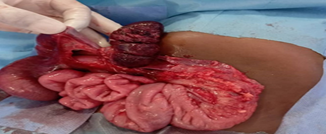
Figure 2: Bladder necrosis after manual reduction
Discussion
Acute intussusception in infants is the most common cause of acute surgical abdomen in infants [5]. It is mostly idiopathic [6]. During our study period, we recorded 93 cases of acute intussusception, 39 of which benefited from hydrostatic reduction, i.e., an annual frequency of 42%. This result differs from that of Zanga [7] who reported an annual frequency of 12.60% with p=0.008. This difference could be explained by the early diagnosis in our context, which lends itself to this therapeutic method and the desire of our team to promote this method. The mean age of patients was 12.9 months, with extremes of 2 months and 24 months. This result is comparable to that of Boumas [8] who found an average age of 9.4 months. This result is within the age range of idiopathic intussusceptions. In our series, the male sex was in the majority with a sex ratio of 2, as in the Tapsoba series [9] which recorded a sex ratio of 1.8. The diagnosis was suggested in the classic triad: paroxysmal abdominal pain or plaintive cry (100%), vomiting (94.9%) and rectorrhagia (46.2%). It was confirmed on ultrasound in all our patients, unlike Boumas [10] who confirmed it on ultrasound in 71.4% of cases. The ileo-caeco-colic form was the most represented, 66.7% as in the Rossignol series [11] and requires rapid management. Intussusception in infants is most often idiopathic and frequently associated with a viral infection. The blood sausage was reduced on the 1st attempt by 76.9% with a success rate of 92.2% in our series. This result differs from that of Badji [12] which recorded 77.8% success. This difference could be explained by our short consultation period and the forms encountered. Our 3 cases of failure were related to complications discovered intraoperatively, in this case intestinal necrosis and perforation. The postoperative follow-up was simple in these 3 patients.
Conclusion
The management of acute intussusception by the hydrostatic reduction method is well feasible in our context and offers good results.
References
- Lamber G, Guérin F, Franchi-Abella S, Boubnova J, Martelli H. (2015). Invagination intestinale aiguë du nourrisson et de l’enfant. J Pédiatrie Puériculture, 28(3) :118-130.
Publisher | Google Scholor - Jaim A, Moussa ZS, Aboubacar C, Sosthène SK, Cherlyn BK, et al. (2023). Ultrasound-guided hydrostatic intestinal disintussusception in children: the experience of the Charles De Gaulle paediatric university hospital in Ouagadougou on 63 cases. J Afr Imag Médicale J Afr Imag Med, 5(1)
Publisher | Google Scholor - Kevin E C, Obinna C.N. (2020). Hydrostatic reduction of intussusception in children: a single-center experiment. Pan Afr Med J, 36 :263.
Publisher | Google Scholor - Vincenzo Restivo et col. (2017). Hospitalization rate for intussusception among children aged 0 to 59 months from 2009 to 2014 in Italy. PubMed, 13(2) :445-449.
Publisher | Google Scholor - Roméo T.Y, Siham EI, Haddad MD, Latifa C.M.D. (2021). Acute intussusception of a child and literature review. Health Global Pediatric, 8 :1-5.
Publisher | Google Scholor - Agbéko F, Fiawoo M, Takassi E.O, Mazini C.A, Andrianirinah risoa I, et al. (2021). Acute intussusception in children: about two cases of misleading disclosure. Journal of Scientific Research of Lomé, 23(3)
Publisher | Google Scholor - Zanga M.S, Coulibaly A, Somda SK, Berehoudougou K C, Sanou M.Z, et al. (2023). Ultrasound-guided hydrostatic intestinal disintussusception in children: the experience of the Charles De Gaulle Paediatric University Hospital in Ouagadougou on 63 cases. J Afr Imag Médicale J Afr Imag Med, 15(1).
Publisher | Google Scholor - Boumas N, Nguema J.H.N, Abègue M, Mindze D, Ntyale O, et al. (2022). Acute intestinal intussusceptions of infants at the Jeanne Ebori Foundation University Hospital in Libreville. Health Sci, 23(5) :127-131
Publisher | Google Scholor - Tapsoba W.T, Wandaogo A, Ouédraogo I, Ouédraogo S.F. (2021). Acute intussusception in children under 5 years of age admitted to a hospital in Ouagadougou from 2008-2013. Pan Afr Med J, 39(5).
Publisher | Google Scholor - Boumas N, Nguema J.H.N, Abègue M, Mindze D, Ntyale O, Ndong F.O. (2022). Acute intestinal intussusceptions of infants at the Jeanne Ebori Foundation University Hospital in Libreville. Health Sci, 23(5):127-131
Publisher | Google Scholor - Rossignol G, Schneider G, Dubois R, Hameury F, Gelas T, Mure P-Y. (2024). Acute intussusception of infants and children. Journal of Pediatrics and Childcare, 37(2) :79-87
Publisher | Google Scholor - BADJI N, DEME B, AKPO G, CHAOUCH A, DRAHA F. (2022). Contribution of ultrasound in acute intestinal intussusceptions in infants. Mali Medical, 37(2) :44-52
Publisher | Google Scholor