

Research Article
Trends of Communicating Perioperative Findings for Patients and Caregivers, And Its Effect on Patient Satisfaction in Tikur Anbessa Hospital, Addis Ababa, Ethiopia-A Prospective Cross-Sectional Study, 2024
- Kidus Geremew 1*
- Berhanu Kotisso
- Dawit Bekele
Addis Ababa University, Addis Ababa, Ethiopia.
*Corresponding Author: Kidus Geremew, Addis Ababa University, Addis Ababa, Ethiopia.
Citation: Geremew K, Kotisso B, Bekele D. (2025). Trends of Communicating Perioperative Findings for Patients and Caregivers, And Its Effect on Patient Satisfaction in Tikur Anbessa Hospital, Addis Ababa, Ethiopia; A Prospective Cross-Sectional Study, 2024, Journal of BioMed Research and Reports, BioRes Scientia Publishers. 7(5):1-10. DOI: 10.59657/2837-4681.brs.25.156
Copyright: © 2025 Kidus Geremew, this is an open-access article distributed under the terms of the Creative Commons Attribution License, which permits unrestricted use, distribution, and reproduction in any medium, provided the original author and source are credited.
Received: April 18, 2025 | Accepted: May 05, 2025 | Published: May 09, 2025
Abstract
Introduction: Perioperative patient and physician communication skills are essential to provide high-quality care to patients. Tikur Anbessa hospital, being Ethiopia's tertiary referral hospital and a center of different surgical specialties, is an ideal place to study the relationship between patients' perioperative communication and its effect on satisfaction. The purpose of this study is to assess the trend of perioperative patient communication and its effect on patient satisfaction in Tikur Anbessa Hospital
Methods: The study was conducted from May 01 to August 30, 2024 at Tikur Anbessa Specialized Hospital. A prospective cross-sectional study was conducted by collecting primary data from interviews. The sample size of 226 was estimated by using the Cochrane formula considering a previous level of satisfaction 84%. Convenience sampling was chosen. Data was entered into SPSS v25. Descriptive and regression analysis done and the outputs presented using tables, graphs, & figures accordingly.
Results: This study shows a mean overall surgical patient satisfaction rate of 67.3%. And among several possible factors contributing to the overall patient satisfaction, this study showed significant association with patients being informed about the diagnosis of illness preoperatively (AOR: 16.9, C.O.R: 0.017 [95% C.I: 0.002-0.129]) Estimated cost and length of stay preoperatively (AOR: 8.65, C.O.R: 0.041 [95% C.I: 0.006-0.305 ]) Intraoperative finding and Procedure done, (AOR 11.74, C.O.R: 0.033 [95% C.I: 0.010-0.110]) Anticipated postop course, (AOR 7.67, C.O.R: 0.035 [95% C.I: 0.008-0.147])
Conclusion: Overall patient satisfaction is fair in Tikur Anbessa Hospital but comparatively lower than the previously reported figures in the literature. Addressing gaps of information with an important focus on preoperative information of patients’ diagnosis, the anticipated course and informing the intraoperative findings and procedures will significantly influence the satisfaction rate.
Keywords: perioperative findings; patient communication; patient-physician relationship; patient satisfaction rate
Introduction
Patient satisfaction has a paramount importance in determining the quality of care a patient is receiving. This satisfaction rate is dependent on several factors among which the proper communication between the treating physician and patient is the primary factor. In a surgical patient, the ideal communication should be done both prior to surgery as well as postoperatively. It is well established from clinical practice and backed by research of many kinds that improved communication between doctors and patients would improve patient satisfaction and compliance. Communication between doctors and patients is also widely recognized as a crucial component of therapeutic procedures [1]. Globally, there is a growing emphasis on assessing patient satisfaction as a means of monitoring the quality of health care provided in health institutions. Assessing patient satisfaction is critical for determining the quality of care delivered by a health system [2]. A surgical patient should be well counseled prior to the surgery about the very small details regarding his treatment course by the most senior treating physician. This communication should include preoperative information regarding the diagnosis of the illness, the planned procedure, estimated cost and length of stay. Following the surgery again the patient should be informed about the exact intraoperative finding and the procedure done. Postoperatively this disclosure should include the anticipated postop course as early postoperatively as possible. Finally, this information should be given by the most senior treating physician and the patient’s understanding should be assessed at the same time.
There are a number of institutional researches done regarding assessment of the level of patient satisfaction in relation to perioperative communication. However, most of these studies have a primary focus on the preoperative counseling part, assessing the patients’ level of understanding and consent to the procedure. According to a survey conducted in the western Amhara Regional State of Ethiopia by Mekdes Alemu et al., 68.7% of surgical patients expressed satisfaction with their experience. Patient satisfaction with surgical services was significantly correlated with factors like age > 58 years, those without formal education, those with only a primary or secondary school education, those without a history of prior surgical admission, length of hospital stay < 7 days, and elective surgical admission [2]. Nevertheless, there was no explicit evaluation of the satisfaction rate with respect to the issue of perioperative communication.
Despite the significance of good communication for surgeons, there are comparatively few studies that describe communication between surgeons and patients; instead, the great majority of the communication literature has concentrated on primary care physicians and internal medicine specialists and their interactions with patients [3].
Tikur Anbessa hospital, being Ethiopia's tertiary referral hospital and a center of different surgical specialties, is an ideal place to study the relationship between patients' perioperative communication and its effect on satisfaction. This research aims to assess our current satisfaction rate at Tikur Anbessa Hospital in all patients who have undergone surgery. It will, at the same time, re-evaluate the gaps emphasizing on perioperative communication and the effect on the patient satisfaction. It will provide solid and objective evidence to redirect focus on the problem and serve as a guide both at institutional and national level to devise curriculums and guidelines in improving surgical patient satisfaction. The findings deepen our current understanding about surgical patient satisfaction being deeply influenced by patients’ understanding of the intraoperative and postoperative factors equally to the preoperative discussion. This study more importantly tries to highlight the specific factors affecting the overall surgical patient satisfaction. This is very important for the treating team of physicians and surgeons to focus their attention. Finally, the results of the study bring about important contributions to making treating physicians accountable in delivering information for the patient every step of the perioperative course of surgical patients.
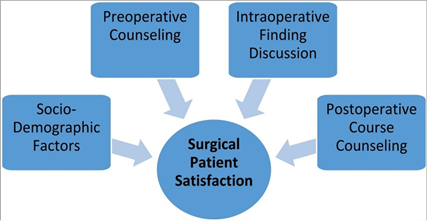
Objectives
General Objectives
- To assess the trend of perioperative patient communication and its effect on patient satisfaction in Tikur Anbessa Hospital.
Specific Objectives
- To determine the overall patient satisfaction among surgical patients in Tikur Anbessa Hospital.
- To evaluate the trend of preoperative counseling in Tikur Anbessa Hospital.
- To evaluate the trend of intraoperative finding discussion in Tikur Anbessa Hospital.
- To evaluate the trend postoperative course discussion in Tikur Anbessa Hospital.
- To assess the effect of perioperative patient counseling on patient satisfaction in Tikur Anbessa Hospital.
Objectives
General Objectives
- To assess the trend of perioperative patient communication and its effect on patient satisfaction in Tikur Anbessa Hospital.
Specific Objectives
- To determine the overall patient satisfaction among surgical patients in Tikur Anbessa Hospital.
- To evaluate the trend of preoperative counseling in Tikur Anbessa Hospital.
- To evaluate the trend of intraoperative finding discussion in Tikur Anbessa Hospital.
- To evaluate the trend postoperative course discussion in Tikur Anbessa Hospital.
- To assess the effect of perioperative patient counseling on patient satisfaction in Tikur Anbessa Hospital.
Methods
The study was conducted from May 01 to August 30, 2024 at Tikur Anbessa Specialized Hospital. Tikur Anbessa Hospital is a specialized hospital in Addis Ababa, Ethiopia, established in 1964. It is a main teaching hospital for both preclinical and clinical training of most disciplines in the School of Medicine of Addis Ababa University [4]. It has 200 doctors, 700 beds, 379 nurses and 115 other health professionals offering health care services. The hospital consists of 950 permanent contract administrative staff that supports the hospital activities. Under School of Medicine, the hospital spans various departments, faculties and residents [4].
Study Design
A prospective cross-sectional study was conducted by collecting primary data from interviews.
Source Population
All surgical patients who underwent surgery in Tikur Anbessa Hospital.
Study Participants
Patients who underwent surgery in Tikur Anbessa Hospital between May 01-August 30.
Sample Size Determination
The sample size was estimated by using the Cochrane formula. Considering the following parameters.

Were, n = the required sample size.; p = previous level of satisfaction 84%.; e = margin of sampling error tolerated (5%) = 0.05.; Z = z value, collected from the z-table confidence interval (95%).; n= (1.96)2 (0.84) (0.16) / (0.05)2 = 206.; With 10% non-response rate the sample size was: 206 + 206 (0.1) = 226.
Sampling Technique
Convenience Sampling.
Inclusion Criteria
All randomly selected elective adult patients who had undergone surgery in Tikur Anbessa of Addis Ababa, Ethiopia.
Exclusion Criteria
- Patients who refused to give consent.
- Pediatrics patients.
- Patients with non-surgical management.
- Patients who are not awake, communicating or unable to respond.
- Patients who require critical care and follow-up postoperatively.
Measurement / Study Variables
Dependent Variables: Surgical patient satisfaction
Independent Variables
Demographic Factors: Age, sex, educational level, residence, admission type, department
Preoperative Counseling:
- Patients’ information of their own diagnosis, procedure, length of stay, cost of treatment.
- Time and place of preoperative counseling [OPD, after admission].
- Who gave the preoperative counseling [operating surgeon, assistant, nurse, intern, other].
- Time of preoperative informed consent.
- Who took the preoperative informed consent.
Intraoperative Finding Discussion:
- Patients’ information of the intraop finding.
- Who discussed the findings [operating surgeon, assistant, nurse, intern, other].
- When was the finding discussed.
- Patients understanding of the finding [Good / Poor].
Postoperative Course Discussion:
- Patients’ information of the postop course.
- Time of discussing the postoperative course.
- Who discussed the anticipated course [operating surgeon, assistant, nurse, intern, other].
- When was the postoperative course discussed.
- Patients understanding of the postoperative course [Good / Poor].
Data Collection
Primary data was collected by interviewing post-operative patients using a structured questionnaire before their discharge.
Data Quality Control
The data will be collected by the primary investigator which will add to the quality and accuracy of the data collected. The data collection process involves patient chart review regarding accuracy of patients understanding of the diagnosis, procedure and postoperative course. The patient card number is used to check validity and completeness of the information.
Analysis
- Data was entered using a prepared form on Google Forms® by the principal investigator and completeness of the data was checked every day.
- Data was entered into SPSS v25 application.
- Descriptive analysis computed as frequency; percentages of different variables were determined.
- Later regression analysis done between the dependent and independent variables.
- Finally, the outputs of processed presented using tables, graphs, & figures accordingly.
Operational Definitions
Patient Satisfaction: The overall subjective score out of 10 given by the patient in describing his / her satisfaction rate, which will be converted into 100%.
Satisfaction: Defined as patient’s subjective satisfaction score > 5 out of 10.
Dissatisfaction: Defined as patient’s subjective satisfaction score ≤ 5.
Good Understanding: Defined as accurate patient’s understanding of the clinical parameter subjectively assessed by the evaluator.
Poor Understanding: Defined as wrong patient’s understanding of the clinical parameter subjectively assessed by the evaluator.
Results
Socio-Demographic Characteristics
Out of the 226 patients, 55.5% were male. Patients’ age ranges from 18-39 years in 46%; 38.9% of patients’ age range from 40-60 years and 15% of patients’ age were above 60. 30% of patients had educational status in primary school; while 23.8% of patients had a secondary school background; 21.1% patients had educational level of university and above while 24.7% have no educational background. 26.9% of patients live in the rural country while 73.1% of patients live in the urban cities.
Table 1: Socio-Demographic Characteristics.
| Variables | Categories | Frequency | Percent (%) |
| Sex | Male | 125 | 55.5 |
| Female | 101 | 44.7 | |
| Age | 18-39 | 104 | 46.0 |
| 40-60 | 88 | 38.9 | |
| lessthan 60 | 34 | 15.0 | |
| Educational Status | Primary | 69 | 30.5 |
| Secondary | 53 | 23.5 | |
| University and above | 48 | 21.2 | |
| None | 56 | 24.8 | |
| Residence | Urban | 165 | 73.0 |
| Rural | 61 | 27.0 |
Admission Characteristics
90.7% of patients were admitted as an elective case while 9.3% of patients were emergency cases. 24.8% of these patients were colorectal patients, while 19% were hepatobiliary, 12.4% were endocrine, 14.6% were General surgery, 9.3% were Urology, 8.4% were Upper GI cases, and 7.1% of them were in cardiothoracic surgery. The remaining 4.5% of the patients were vascular surgery patients.
Table 2: Admission Characteristics.
| Variables | Categories | Frequency | Percent [%] |
| Department | HPB | 43 | 19.0 |
| Endocrine | 28 | 12.4 | |
| Upper GI | 19 | 8.4 | |
| General | 33 | 14.6 | |
| Colorectal | 56 | 24.8 | |
| Urology | 21 | 9.3 | |
| Cardiothoracic | 16 | 7.1 | |
| Vascular | 10 | 4.4 | |
| Admission Type | Elective | 206 | 90.7 |
| Emergency | 21 | 9.3 |
Preoperative Counseling
Out of the 226 respondents 92% patients were informed about the diagnosis of their illness, 83.2% patients about the planned procedure preoperatively while 79.2% patients were not informed about estimated cost and length of stay preoperatively. In 90.7% of the patients, counseling was given at the OPD and in the rest 9.3% counseling was given after admission. The preoperative counseling was given by a surgeon in 46.9% of patients, 25.7% by residents, 1.8% by interns and 25.7% of patients don’t know the counseling physician. Informed consent for the surgery was taken a day before admission in 73.9% of patients; on the day of surgery in 22% of patients and at admission in 4% of patients. The informed consent was taken by interns in 60.2% of patients, by residents in 35% of patients, by surgeons in 1.8% of patients and 3.1% of patients don’t know the physician. 54% of patients have good understanding of the treatment course and 46% of them had poor understanding of the perioperative course as judged by the investigator.
Table 3: Preoperative Counseling.
| Variables | Categories | Frequency | Percent (%) |
| Patient Informed about diagnosis of illness preoperatively | Yes | 208 | 92.0 |
| No | 18 | 8.0 | |
| Patient informed about the planned procedure preoperatively | Yes | 188 | 83.2 |
| No | 38 | 16.8 | |
| Patient informed about estimated cost and length of stay preoperatively | Yes | 47 | 20.8 |
| No | 179 | 79.2 | |
| When was the preoperative counseling given? | At OPD | 205 | 90.7 |
| After admission | 21 | 9.3 | |
| Who gave the preoperative counseling | Surgeon | 106 | 46.9 |
| Resident | 58 | 25.7 | |
| Intern | 4 | 1.8 | |
| Don’t Know | 58 | 25.7 | |
| When was informed consent taken? | At Admission | 9 | 4.0 |
| A day before surgery | 167 | 73.9 | |
| On the day of surgery | 50 | 22.1 | |
| Who took the preoperative consent | Resident | 79 | 35.0 |
| Intern | 136 | 60.2 | |
| Don’t know | 7 | 3.1 | |
| Surgeon | 4 | 1.8 | |
| How well the patient understood the anticipated postop course?" | Good | 122 | 54.0 |
| Poor | 104 | 46.0 |
Intraoperative Finding Discussion
Out of the 226 patients, 55.3% of them were not informed about the intraop finding and procedure done. Among those informed, 39% of them were informed during ward rounds; 32.4% of them were informed just after the procedure and 29.5% of them were informed on the day of surgery. Most of this information was given by the operating surgeon in 43.8%; assistant surgeon in 33%, residents in 13.3%; OR nurse and intern contribute for 1
Discussion
This study shows a mean overall surgical patient satisfaction rate of 67.3%. And among several possible factors contributing to the overall patient satisfaction, this study showed significant association with patients being informed about
- The diagnosis of illness preoperatively (AOR: 16.9, C.O.R: 0.017 [95% C.I: 0.002-0.129]).
- Estimated cost and length of stay preoperatively (AOR: 8.65, C.O.R: 0.041 [95% C.I: 0.006-0.305]).
- Intraoperative finding and Procedure done, (AOR 11.74, C.O.R: 0.033 [95% C.I: 0.010-.110]).
- Anticipated postop course, (AOR 7.67, C.O.R: 0.035 [95% C.I: 0.008-0.147]).
This result is comparable but slightly lower than the study done by Mekdes Alemu et.al in western Amhara Regional State, Ethiopia, which revealed a satisfaction rate of 68.7% [2]. However, the satisfaction rate in the later study was not specifically assessed regarding the consideration of perioperative communication.
Again, this result is significantly lower than a study conducted at the University of Gondar which revealed that 98.1% of patients were satisfied with the perioperative surgical service they received. The variables that had association with good outcome were: Information about the disease and operation, operation theater staff attention of the patients complains [5].
In this study, even though there were good number of patients being informed about their diagnosis and planned procedure [91%, 83% respectively], 78% of patients were not informed about the cost of the procedure and the estimated length of stay. This has brought a significant effect on the patient satisfaction result.
There’s overall patient understanding of the intraop finding and procedure was poor in nearly half of the patients (50.7%); this factor was also found to have significant association with the poor satisfaction of the surgical patients.
Conclusion
The surgical department and staff should make it a trend to give patients the information regarding their diagnosis, estimated cost and length of ward stay and anticipated postop course. This practice should again be monitored using regular assessment and monitoring methods. The rate of preoperative counseling and the involvement of surgeons was remarkably good. The surgical staff should be encouraged to continue providing this constant level of care. Postoperative findings should be notified to patients by the operating team as early in the postop course of the procedure. More importantly the informing health professional should make sure the patient is well informed.
Abbreviations
IOF: Intraoperative Finding
Intraop: Intraoperative
Postop: Postoperative
OPD: Outpatient Department
IPD: Inpatient Department
OR: Operation Room
AAU: Addis Ababa University
CHS: College of Health Sciences
LPPSq: Leiden Perioperative care Patient Satisfaction questionnaire
Declarations
Ethical Considerations
Ethical approval was obtained from the Department of Research and Ethics Review Committee (DRERC) of Addis Ababa University College of Health Sciences, Ethical Review Committee Office (ERCO) and Addis Ababa Health Bureau IRB (Internal Review Board).
A letter informing Tikur Anbessa Hospital will be collected from the Ethical committee of the Departmental Research and Ethics Review Committee (DRERC) about the study. All eligible charts will be retrieved and patients were interviewed
All the information obtained from the study subjects were coded to maintain confidentiality
Consent for Publication
Not applicable.
Availability of data and materials
The datasets used and/or analyzed during the current study are available from the corresponding author on reasonable request.
Competing Interests
The authors declare that they have no competing interests.
Funding
Addis Ababa University, Department of Surgery, 25,000 Ethiopian Birr.
Authors’ Contribution
KG has participated in the conception and design of the work, data collection, and interpretation an analysis and final preparation of the thesis.
BK has participated in the conception and design of the work, revision of the final results and analysis and approved the submitted version.
DB has also participated in revision of the final results and analysis and approved the submitted version.
All authors agreed reviewed and are personally accountable for the contributions in the paper and ensure any questions related to the accuracy or integrity of any part of the work, even ones in which the author was not personally involved, are appropriately investigated, resolved, and the resolution documented in the literature
Acknowledgement
I would like to acknowledge the Department of Surgery, Addis Ababa University, College of Health Science for preparing such an opportunity for residents to exercise research in health-related topics and to study the gaps pertaining to our day-to-day surgical activity and bring about helpful recommendations in the field of surgery.
My next gratitude goes to my colleagues Dr Nardos Mulu and Fiker Gezahegn in reviewing this research proposal and their notable comments.
References
- Trummer, U. F., Mueller, U. O., Nowak, P., Stidl, T., Pelikan, J. M. (2006). Does Physician-Patient Communication That Aims at Empowering Patients Improve Clinical Outcome? A Case Study. Patient Education and Counseling, 61(2):299-306.
Publisher | Google Scholor - Alemu, M. E., Worku, W. Z., Berhie, A. Y. (2023). Patient Satisfaction and Associated Factors Towards Surgical Service Among Patients Undergoing Surgery at Referral Hospitals in Western Amhara Regional State, Ethiopia. Heliyon, 9(3).
Publisher | Google Scholor - Levinson, W., Hudak, P., Tricco, A. C. (2013). A Systematic Review of Surgeon-Patient Communication: Strengths and Opportunities for Improvement. Patient Education and Counseling, 93(1):3-17.
Publisher | Google Scholor - Wikipedia Contributors. (2024). Black Lion Hospital. Wikipedia; Wikimedia Foundation.
Publisher | Google Scholor - Gebremedhn, E. G., Lemma, G. F. (2017). Patient Satisfaction with The Perioperative Surgical Services and Associated Factors at A University Referral and Teaching Hospital, 2014: A Cross-Sectional Study. Pan African Medical Journal, 27(1).
Publisher | Google Scholor