
Research Article
Lucid Technique for Fabrication of Hollow Maxillary Prosthesis - A Clinical Technique
1Assistant Professor, Department of Prosthodontics and Crown & Bridge, JSS Dental College & Hospital, A Constituent College of JSS Academy of Higher Education & Research, SS Nagar, Mysuru-570015, Karnataka, India.
2Professor, Department of Prosthodontics and Crown & Bridge, JSS Dental College & Hospital, A Constituent College of JSS Academy of Higher Education & Research, SS Nagar, Mysuru-570015, Karnataka, India.
3Professor & Head of the Department, Department of Prosthodontics and Crown & Bridge, JSS Dental College & Hospital, A Constituent College of JSS Academy of Higher Education & Research, SS Nagar, Mysuru-570015, Karnataka, India.
*Corresponding Author: Naga Usha N, Assistant Professor, Department of Prosthodontics and Crown & Bridge, JSS Dental College & Hospital, A Constituent College of JSS Academy of Higher Education & Research, SS Nagar, Mysuru-570015, Karnataka, India.
Citation: Naga Usha N, Anupama Aradya A, Ganesh S, Raghavendraswamy K.N. (2025). Lucid Technique for Fabrication of Hollow Maxillary Prosthesis - A Clinical Technique. Dentistry and Oral Health Care, BioRes Scientia Publishers. 4(4):1-7. DOI: 10.59657/2993-0863.brs.25.056
Copyright: © 2025 Naga Usha N, this is an open-access article distributed under the terms of the Creative Commons Attribution License, which permits unrestricted use, distribution, and reproduction in any medium, provided the original author and source are credited.
Received: November 21, 2025 | Accepted: December 10, 2025 | Published: December 22, 2025
Abstract
Complete dentures are removable dental prostheses used to rehabilitate completely edentulous maxillary and mandibular arches. The prime requirements for a successful denture treatment are adequate retention, stability, and comfort. Maxillary Denture becomes bulky in severely resorbed ridges with a long upper lip and when there is a large restorative inter arch space. Hollow dentures are typically indicated in these situations, as the increased weight of the maxillary denture can reduce the retention and stability of the dentures. A hollow denture is a prosthesis with a space within it to reduce its weight. This article describes a straightforward technique for the fabrication of a hollow denture in a single stage using Putty and Base plate wax. The novel method excludes the multiple steps involved in the fabrication of a hollow denture using the conventional method. This method led to 6.5 grams reduction in the weight of the Prosthesis, which enhanced retention and stability of the denture.
Keywords: complete denture; maxillary denture; hollow denture; putty index; edentulous arches
Introduction
Severe resorption of the alveolar ridge leads to narrow or flat, constricted maxillary and mandibular ridges, which results in a large restorative space. Maxillary and mandibular dentures become heavier due to the increased inter-arch space. The bulkier prosthesis is proved to be advantageous for the mandibular arch [1] but taxes the maxillary arch as it diminishes the retention and stability. Heavy maxillary denture aggravates the poor denture-bearing ability of the underlying tissue, increases the dislocating forces and also reduces the comfort of wearing the prosthesis [2,3]. Hollow dentures are indicated in these situations. Reducing the weight of the maxillary prosthesis prevents the transmission of detrimental forces to the ridges and leverage action [3]. Several techniques have been employed in fabrication of hollow dentures such as dental stone, salt crystal, soap, sugar, modelling clay, soap, etc. The disadvantage of these techniques is that it involves creating a hole in the processed denture to remove the material and chances of moisture leakage.
This article describes a straightforward technique using Polyvinyl siloxane putty material to achieve a hollow cavity within the maxillary dentures in single flask. The main advantage of this method is that prevents creating hole in processed denture and dentures are fabricated in a single-step using a single flask.
Technique
A 72-year-old male patient reported to the Department of Prosthodontics and Crown & Bridge, JSS Dental College & Hospital, Mysuru, with a chief complaint of missing teeth and wanted a replacement. Medical history was not significant. Intraoral examination revealed mandibular and maxillary edentulous ridges. Ridges were resorbed, with an increased inter-ridge distance.
Conventional steps for denture fabrication were followed. After the teeth setting trial was satisfactory, the dentures were sealed to the definitive cast. The casts were invested in the flask followed by de-waxing it in a conventional manner (Figure 1,2). layer of base plate wax (Hindustan modelling wax, Hyderabad, India) was adapted on the counter flask over the teeth portion of the denture up to a level where it touches the maxillary cast on the base flask. The thickness of the adapted wax was measured using a periodontal probe to ensure adequate depth. Stoppers was carved on the 2nd premolar and 1st molar regions on the adapted wax. Correspondingly, a layer of wax was adapted over the maxillary cast on the base flask, which would be replaced by a heat-cured acrylic resin denture base.
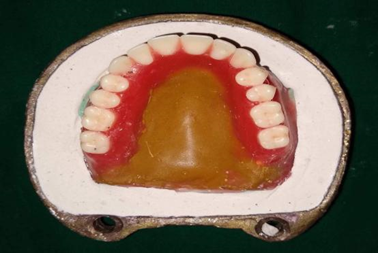
Figure 1: Flasked Trial Denture.
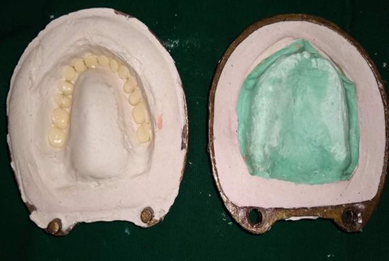
Figure 2: Counter & base flask after dewaxing.
Flasks were trial closed under hydraulic pressure to ensure adequate contact of the adapted wax layers, excess was removed. A small amount of polyvinyl siloxane Putty (Dentsply Sirona Aquasil putty, Delhi) was mixed and placed over the adapted wax on the counter flask. Before the initial set of putty, a trial closure was done under pressure, excess putty was removed (Figure 3, 4), which formed a putty index. The Putty index was then reoriented on the counter flask wax and checked for proper orientation. The flasks were reassembled and verified for complete closure of flasks with putty index in place. Wax and putty were removed from the flask. A Tin foil substitute (DPI cold mould seal, Mumbai, India) was applied over the flask.
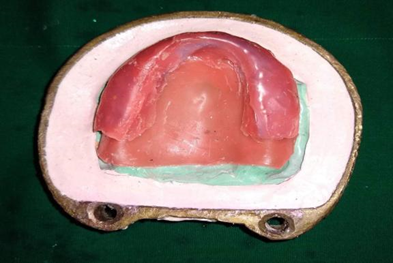
Figure 3: Wax adapted over counter and base and flasks were trial closed under hydraulic pressure.
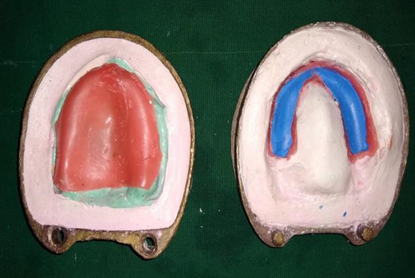
Figure 4: Putty molded on counter flask after trial closure under hydraulic pressure.
Heat cure acrylic resin (DPI Heat cure acrylic resin, Mumbai, India) was manipulated and packed in dough stage onto base and counter flask. Quickly the putty index was placed over the heat cure acrylic resin in the counter flask (Figure 5a, 5b), a Cellophane sheet was placed over the putty and resin in the counter flask. Trial closure of the flask was done under hydraulic pressure (1000 psi) with the putty index in place and excess acrylic resin was cut. Trial closure was repeated for several times until there is no excess acrylic resin flash (Figure 6). Later the Putty index was removed and flask was closed under hydraulic pressure, bench cured and processed in a conventional manner. The Processed denture was recovered from the flasks in usual manner, the dentures were Remounted, necessary occlusal adjustment was done, Finished and Polished. Denture insertion was done with necessary corrections in patient’s mouth.
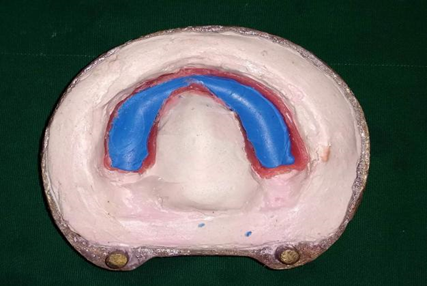
Figure 5a: Putty Index over wax.
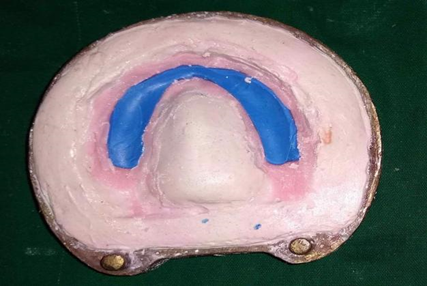
Figure 5b: Putty Index adapter over resin.
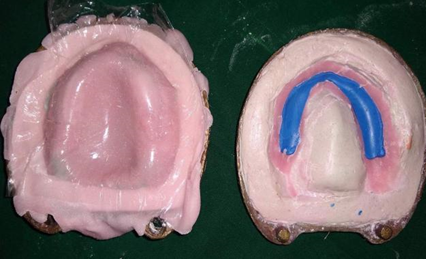
Figure 6: Flash after trail closure.
The Processed Denture was duplicated in self-cure acrylic resin and weight of both the prosthesis was evaluated. A float test was performed on the processed denture which indicated the light weight of the prosthesis.
Discussion
Reducing the weight of prosthesis improves the denture bearing ability, prevents transmission of destructing forces to the supporting tissues, and enhances Retention and Stability. when there is extreme bone resorption or large restorative space, use of hollow dentures has been advocated. Several materials like magnets, suction disks, intra-mucosal inserts and lightweight dentures were used previously, to enhance the retention and stability [4].
In the present case there was a large restorative space with a long upper lip which resulted in increased height of trial maxillary denture, hence hollow denture was opted. A hollow denture is a type of prosthesis wherein a space is created within the denture to reduce the weight of the prosthesis. Aggrawal et al., advocated "Lost salt technique" [5,6] wherein heat-cured acrylic resin was adapted to counter and base flask after conventional de-waxing of the flask, over the adapted resin, salt crystals were added and covered by another layer of acrylic resin, after processing, holes were drilled in the Denture and the salt was then cleansed with water. However, it failed to sustain pressure produced during flask closure resulting inadequate hollow cavity inside the prosthesis and also denture porosity was seen after processing the Denture [7,8].
Gopinadh et al used bean balls, cellulose balls and polyacrylic fibres, which were placed during packing of Heat cure resin and processed, they were left within the denture, hence called whispy prostheses [8]. Others materials like plaster-pumice, sugar [9] modelling clay, alum crystal [10], auto polymerizing acrylic resin shell, cellulose balls, polyacrylic fibres, surgical catheter, orthodontic wire, gelatin, glycerin soap, caramel [11] foam,[12] were used to create hollow cavity in denture.
Chocolate and caramel were also used by some authors, but they were tacky, sticky to use and caramel was brittle which could break under compression. O'Sullivan et al, made a transparent pressure-formed matrix on outer contour trial denture to make silicon putty template and a part of denture was polymerized, but this involved additional steps for fabrication and was also technique sensitive. Thermocoal was employed by few authors, which was left within the denture, the drawback was the denture looked ugly and seemed to have porosity, also the exact thickness could not be measured and it gets displaced under compression molding.
Fine et al employed a Double-flask technique to minimize denture weight. In this technique a pair of separate dental flasks with interchangeable counters was used, wherein one set of flasks is used to first fabricate a permanent denture base and a second set of flasks is used to pack heat cure acrylic resin over the teeth. The precise fit between the base of one flask and the counter of the other flask is crucial, since an incorrect fit may lead to changes in vertical dimension, also it is cumbersome and more time-consuming. Alternatively, a technique involved fabrication of dentures in two pieces individually or around a 3D spacer, thereafter the individual pieces were joined using auto polymerizing acrylic resin [6]. The issue with these techniques is an increased chances of fluid leakage into the denture cavity as a junction is formed between the previously polymerized portions of the denture.
High viscosity Addition silicone impression material also known as Putty exhibits high tensile strength, low shrinkage after Polymerization, and high tear resistance due to its high filler content, which makes Putty a good choice of material for making a template for the planned hollow cavity inside the processed denture. Putty is mixed and adapted onto the wax on the counter flask in its initial stage, its sets hard and assumes the shape of the planned hollow cavity.
Unlike others, the present technique allows fabrication of hollow denture as a single unit in a single stage. A single flask was used during processing which saves time, eliminated extra steps of double flasking and need for further adjustment in patient’s mouth.
Use of single flask allows the operator to achieve a trial closure with the temporary putty spacer, which creates space and prevents any excess pressure over it during the final closure. It also enables verification of adequate resin thickness around the planned hollow space. The chances of micro leakage and seepage of fluids are eliminated as auto polymerizing resin is not used.
Few authors have employed silicone putty to create hollow denture by incorporating putty inside the heat cure resin during packing and curing along with denture, after which two openings were cut with a bur into the denture base, the putty was removed using a sharp instrument. Subsequently, self-cure acrylic resin was used to close the openings. The challenge was difficult to retrieve putty. Whereas the present technique involves making putty index and retrieving it before processing the denture, ensures the adequate thickness of the denture material over the counter and base flask, also there was no need of creating openings in the denture to retrieve the material. There was clean processing without porosity as the putty doesn't affect the polymerization.
In another study Putty was used to create space for hollow denture which was then replaced by a soap spacer. The disadvantage was it ultimately led to creating an opening in the processed denture [7]. In another technique a spacer was designed scanning a putty index and a 3D photo polymer resin was printed and polymerized along with the heat cure resin using double flask technique [13]. The drawbacks being the expense and availability of 3D scanners, printers, and dental SG resin materials and also the thickness of dental SG resin reduces the hollow space within the prosthesis.
The present technique is simple modification in the conventional procedure with Base plate wax as a spacer that was replaced by heat cure acrylic resin. adapted wax ensures adequate thickness of acrylic resin. Putty in the initial stage of setting is molded to fill-in the future hollow space created by the adapted wax. Putty captures the exact details of adapted wax, simulates it on acrylic resin. It does not undergo dimensional changes. Stoppers were made for putty index which aided in proper orientation of putty index on the acrylic resin. The flasks are trial closed for several times under pressure and flash is trimmed after every trial closure until all the excess acrylic resin flows out. Putty index will be removed before the final closure of the flask (Figure 7).
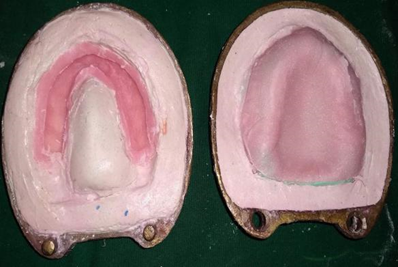
Figure 7: Putty index and excess resin removed after trail closure.
The main advantage of this technique is that it is a single stage procedure and single flask involved with no additional step, there is no line of demarcation in the prosthesis and no need to create opening in the prosthesis to recover the putty. Weight reduction was evaluated by duplicating the prosthesis in auto polymerizing resin [14] there was a significant weight difference between them (Figure 8) (8a-Hollow denture -21.3 grams, 8b-Duplicated denture - 27.8 grams). A denture float test was performed to verify the hollowness of prosthesis [9] (Figure 9).
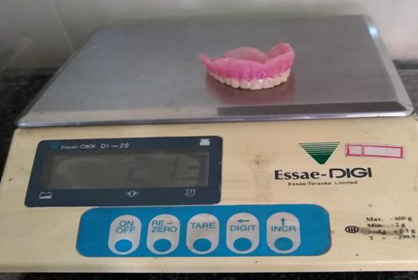
Figure 8a: Weight of processed denture.
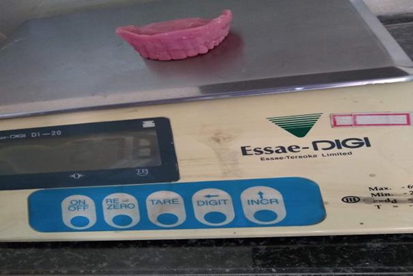
Figure 8b: Weight of duplicated denture.
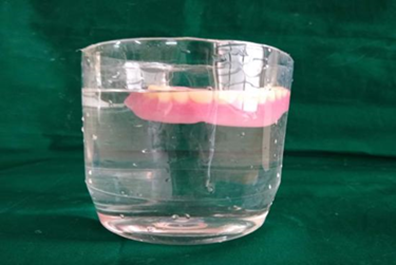
Figure 9: Float Test.
Conclusion
A hollow maxillary complete denture significantly lowers the weight of the prosthesis, which prevents transmission of harmful stresses to the underlying tissues as they would with a conventional heavy prosthesis. As a result, it aids in maintaining bone and underlying tissues. The need for double flasks and the additional step in fabricating Denture is eliminated by using this single flask technique. There is even distribution of hollow space using putty, without creating holes or modifying the processed denture. It is therefore a straightforward, cost-effective, time-saving, and reliable method.
Declarations
Conflict of Interest
Nil.
Ethical Approval and Patient Consent
The present manuscript did not require ethical clearance as patient Identity or information is not shared also an informed consent was taken from the patient. It is a modification of routinely followed procedure.
Acknowledgements & Competing Interests
Nil.
References
- Hosono, K. (1960). The weighted methods to support the lower full denture. J Jpn Prosthodont Soc, 4:81-86.
Publisher | Google Scholor - O'Sullivan, M., Hansen, N., Cronin, R. J., Cagna, D. R. (2004). The hollow maxillary complete denture: A modified technique. The Journal of Prosthetic Dentistry, 91(6):591-594.
Publisher | Google Scholor - Gundawar, S., Zamad, A., Gundawar, S. (2014). Light weight dentures: An innovative technique. Contemporary Clinical Dentistry, 5(1):134-137.
Publisher | Google Scholor - Baslas, V., Kaur, S., Singh, K., Aggarwal, H., Kumar, P. (2015). A revised technique for fabrication of hollow mandibular denture: A solution to severely resorbed residual ridge. Saudi Journal of Oral Sciences, 2(1):43-46.
Publisher | Google Scholor - Aggarwal, H., Jurel, S. K., Singh, R. D., Chand, P., Kumar, P. (2012). Lost salt technique for severely resorbed alveolar ridges: An innovative approach. Contemporary Clinical Dentistry, 3(3):352-355.
Publisher | Google Scholor - Qanungo, A., Aras, M. A., Chitre, V., Mysore, A., Da Costa, G. C. (2016). An innovative and simple technique of hollow maxillary complete denture fabrication. Journal of Clinical and Diagnostic Research: JCDR, 10(8):ZD23.
Publisher | Google Scholor - Barman, J., Rahman, R., Bhattacherjee, S. (2020). Fabrication of hollow maxillary complete denture: A simplified technique. Int J Oral Health Dent, 6(1):63-65.
Publisher | Google Scholor - Rupal Shah, Ekta Chheda, Bansri Tank, Hemangi Lad, Monika Varma. (2024). Innovative solutions for challenging anatomical traits: comparing different hollow denture fabrication techniques. Int J Health Sci Res. 14(4):226-235.
Publisher | Google Scholor - Bhandari, A., Singh, S. K., Suwal, P., Parajuli, P. K., Manandhar, A. (2013). Rehabilitation of severely resorbed maxilla with a hollow maxillary complete denture. Health Renaissance, 11(3):281-283.
Publisher | Google Scholor - Mawani, D. P., Muddugangadhar, B. C., Das, A., Kothari, V. (2018). Flasking technique with alum crystals for fabricating definitive hollow bulb obturators. The Journal of Prosthetic Dentistry, 120(1):144-146.
Publisher | Google Scholor - Bhushan, P., Aras, M. A., Chitre, V., Mysore, A. R., Mascarenhas, K., et al. (2019). The hollow maxillary complete denture: a simple, precise, single‐flask technique using a caramel spacer. Journal of Prosthodontics, 28(1):e13-e17.
Publisher | Google Scholor - Dukes, B. S., Barnett, M. O., Kniejski, M. E. (1980). A method for the duplication of complete dentures. The Journal of the American Dental Association, 101(3):490-491.
Publisher | Google Scholor - Shah, R. J., Lagdive, S. B., Machchhar, A. H., Periyanan, K., Cherian, S. (2020). Technique to fabricate hollow maxillary complete denture using 3D printed template. Journal of Prosthodontics, 29(4):360-363.
Publisher | Google Scholor - Tanaka, Y., Gold, H. O., Pruzansky, S. (1977). A simplified technique for fabricating a lightweight obturator. The Journal of Prosthetic Dentistry, 38(6):638-642.
Publisher | Google Scholor