

Research Article
Insect Pests Associated with Pumpkin Crop (Cucurbita Moschata) At Golaghat District of Assam, India
- Bhaskar Pathak *
School of Entrepreneurship and Management, Assam Rajiv Gandhi University of Cooperative Management, Basic Tinali, Joysagar, Sivasagar, Assam, India.
*Corresponding Author: Bhaskar Pathak, School of Entrepreneurship and Management, Assam Rajiv Gandhi University of Cooperative Management, Basic Tinali, Joysagar, Sivasagar, Assam, India.
Citation: Pathak B. (2025). Insect Pests Associated with Pumpkin Crop (Cucurbita Moschata) At Golaghat District of Assam, India. Clinical Case Reports and Studies, BioRes Scientia Publishers. 10(1):1-7. DOI: 10.59657/2837-2565.brs.25.244
Copyright: © 2025 Bhaskar Pathak, this is an open-access article distributed under the terms of the Creative Commons Attribution License, which permits unrestricted use, distribution, and reproduction in any medium, provided the original author and source are credited.
Received: March 12, 2025 | Accepted: March 26, 2025 | Published: April 03, 2025
Abstract
Insect pests affecting pumpkin crops (Cucurbita moschata) at Golaghat district of Assam, India, were investigated during two Rabi seasons (October/November - March/April) in 2022 and 2023. Fortnightly observations at both vegetative and reproductive stages identified seven major pests: red pumpkin beetle (Raphidopalpa foveicollis, A. cincta, and A. intermedia), fruit fly (Bactrocera cucurbite), aphis (Aphis gossypii), leaf miner (Liriomyza spp.), whitefly (Bemisia tabaci), and spider mites (Tetranychus urticae). The overall trend of incidence was low to moderate, with variability with highest incidence 10.22% on 12.11.2023, generally lower levels, suggesting a significant pest pressure and slightly higher incidence in 2023-2024 season. The highest incidence was 15.32% on 10.02.2024 demonstrates significant and persistent pest pressure. The most significant pests were fruit flies (Bickocera cucurbatae), Aphids, leaf miners, and spiders. The analysis indicates that weather conditions, particularly temperature, have significant relationships with pest incidence. This information can be crucial for agricultural planning and pest management strategies, as understanding these relationships allows for better predictions of pest outbreaks based on weather forecasts.
Keywords: insect pests; pumpkin crops; golaghat district; rabi seasons; red pumpkin beetle; fruit fly; aphis; weather conditions; pest incidence; agricultural planning
Introduction
Pumpkins, scientifically known as Cucurbita moschata are versatile crops with significant culinary, nutritional, and agronomic benefits. They are native to northeastern Mexico and the southern United States and have been domesticated for over 7,000 years. Today, pumpkins are grown on all continents, with major producers including the United States, India, China, and Mexico. Pumpkins exhibit a wide diversity of fruit characteristics, ranging in size from less than 100 grams to over 20 kilograms. The fruits can be round, long, or flat, with or without ribs, grooves, furrows, wrinkles, or warts. They come in various colors, including green, yellow, and orange, with shades ranging from almost black to almost white1. Pumpkins thrive in warm climates, requiring full sun and well-drained, fertile soil. They prefer temperatures between 18°C and 24°C for optimal growth. India is the second-largest producer of pumpkins (Apni Kheti, 2025). The crop is grown throughout the country, with major pumpkin-growing states including Orissa, Assam, Rajasthan, and Punjab (Horticulture Guruji, 2025). In Assam, pumpkins are cultivated extensively, with the region's climatic conditions being highly suitable for their growth and development. The average yield of pumpkins in Assam can reach up to 189 quintals per hectare when using high-yielding varieties like Arjuna F1 (Dihingia et al., 2023). Pumpkin plants are prone to various pests that can cause substantial damage. These include primarily red pumpkin beetle (Raphidopalpa foveicollis), pumpkin beetle (Aulacophora foveicollis, A. cincta, A. intermedia), fruit fly (Bactrocera cucurbitae), aphids (Aphis gossypii), leaf miner (Liriomyza spp.), whitefly (Bemisia tabaci), and spider mites (Tetranychus urticae). These pests feed on the sap of the plants, causing significant harm. Borers bore holes into the vines and fruits, making them unmarketable and causing significant yield losses. Squash Bugs feed on leaves, sucking out the sap and causing the foliage to wilt, turn brown, and die. Flea Beetles chew small holes in pumpkin leaves, creating a "shotgun" appearance. Large infestations can cause significant damage, especially in young plants. Pumpkin crops in Assam face higher pest infestations due to climate, agro-climatic variability (Choudhury and Das, 2023), traditional farming practices (Nath and Ray, 2012), lack of integrated pest management (IPM), mono cropping, and limited access to resources. The warm and humid climate, varying agro-climatic conditions and traditional farming practices can lead to increased pest populations and crop damage. Inconsistent use of IPM practices, mono cropping, and limited access to resources in remote areas can further exacerbate the problem. Addressing these challenges requires a combination of modern pest management techniques, farmer education, and improved access to resources. To effectively manage pests, it is essential to analyze the various factors influencing population fluctuations, as this can help forecast their occurrence in specific regions (Ghosh & Mandal, 2015) (Dhaliwal & Arora, 2010) and (Kumar & Singh (2013). Previously, there was a lack of research on the seasonal incidence of major insect pests of pumpkin in the Assam region of India. This study was conducted to provide insights into the peak activity periods of these insect pests.
Materials and Methods
In order to determine the prevalence of the main insect pests in the pumpkin ecosystem, a survey was conducted in several farmers’ fields in the Golaghat district of Assam during the rabi seasons of 2022 and 2023. From November to February, observations were made every two weeks based on the damage caused by the main insect pests and their population dynamics. In the vegetative and reproductive (November–December/ January–February) stages of pumpkin, observations were made. Insect collection nets and hand picking were used to gather several insect problem species. Major insect pests were discovered through surveillance based on the level of damage. By referring to established taxonomic keys and relevant literature, the gathered arthropods were sorted, numbered, and their morphological characteristics were identified. The percentage of insect pest damage was calculated using the formula suggested by (Basit & Bhattacharya 2001) for calculating the percentage of insect pest damage is as follows:
This formula helps in assessing the extent of damage caused by insect pests on crops during the growing period, allowing farmers to take appropriate measures for pest management.
The Basit and Bhattacharya (2001) formula for pest damage in agricultural crops is given by:
D=
Where D is the percentage of damage; Y is the yield of the crop without pest damage; Yd is the yield of the crop with pest damage.
Results and Discussion
Red pumpkin beetle (Raphidopalpa foveicollis)
The overall trend of the incidence of red pumpkin beetle was generally high incidence throughout the observation period, with fluctuations. The highest incidence was reported 12.24% on 12.11.2022 and 13.33% on 27.12.2023, relatively consistent high levels, suggesting a significant pest pressure and slightly higher incidence in 2023-2024 season. Young seedling damage is frequently disastrous, resulting in bare spots in the field from plant death and delayed crop maturation. On occasion, the beetles congregate and feed on the leaves of older plants further accelerating the damage (Rahman & Uddin, 2016).
Table 1: Major insect Pest of pumpkin in Golaghat District of Assam
| SL No | Common Name | Scientific name | Order: Family |
| 1 | Red pumpkin beetle | Raphidopalpa foveicollis | Coleoptera: Chrysomelidae |
| 2 | Pumpkin beetle | Aulacophora foveicollis, | Coleoptera: Chrysomelidae |
| 3 | Fruit fly | Bactrocera cucurbitae | Diptera: Tephritidae |
| 4 | Aphids | Aphis gossypii | Hemiptera: Aphididae |
| 5 | Leaf miner | Liriomyza spp | Diptera: Agromyzidae |
| 6 | Whitefly | Bemisia tabaci | Hemiptera: Aleyrodidae |
| 7 | Spider mites | Tetranychus urticae | Trombidiformes: Tetranychidae |
Pumpkin beetle (Aulacophora foveicollis, A. cincta, A. intermedia)
The overall trend was low to moderate incidence, with variability with highest incidence 10.22% on 12.11.2023, generally lower levels compared to the red pumpkin beetle and increased incidence in the beginning of 2023-2024 season. The pumpkin beetle was lower due to climate and weather conditions, natural predators and parasites, good agricultural practices, host plant availability and ecological factors. The overall ecological balance in the region, including soil health and biodiversity, can impact beetle populations (Nath & Ray 2012). Healthy ecosystems with diverse flora and fauna can help regulate pest populations naturally (Table 2).
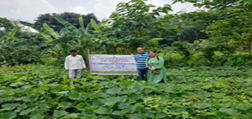
Figure 1
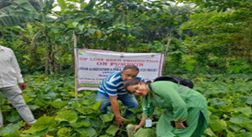
Figure 2
Fruit fly (Bactrocera cucurbitae)
Female fruit flies lay their eggs in the pumpkin fruit, and the hatched larvae feed on the flesh, causing decay and damage. This feeding by the larvae causes the pumpkin to rot and often leads to secondary infections by other pathogens. The ooverall trend was low incidence, with some minor increases. Generally low levels throughout, yet slight increases observed in late December and early January. So, it can be said that starting control measures early and using a combination of cultural, physical, and chemical control methods can effectively manage fruit fly populations (Vasudha et al., 2020).
Aphids (Aphis gossypii)
Although small in sizes, aphids can be quite the nuisance for pumpkin plants. They cause damage in by sap sucking, growth of honeydew and sooty mold, transmits virus and distorting growth. Among all the pests observed during the experiment, the attack of aphid was the highest. The incidence of aphids was cconsistently high incidence throughout the observation period. The highest incidence was 15.32% on 10.02.2024 demonstrates significant and persistent aphid pressure. Incidence increases as the season progresses with higher incidence in 2023-2024 season. Aphids are notorious for transmitting plant viruses. As they move from one plant to another, they can spread diseases that can be detrimental to pumpkin plants (Bhat &Rao, 2020).
Leaf miner (Liriomyza spp.)
There was a moderate incidence, with fluctuations. Highest incidence: 9.98% on 12.11.2023. and the incidence varies, but it is a consistent pest. Higher incidence in the beginning of the 2023-2024 season. Leaf miners are pesky little insects that can cause significant damage to pumpkin plants. These pests lay their eggs within the leaves, and the larvae create visible mines as they feed. This can lead to reduced photosynthesis, yellowing, and falling leaves, ultimately affecting the plant's productivity (UC IPM) and (Desikheti).
Whitefly (Bemisia tabaci)
Overall Trend of its incidence was moderate incidence, with some variability. Highest incidence was 8.20% on 12.11.2023, and 8.00% on 27.11.2023. Although levels fluctuate, but it is a consistent pest. There was higher incidence in the beginning of the 2023-2024 season. . Whiteflies feed on the sap of pumpkin plants by piercing the leaves with their mouthparts. This can weaken the plant and reduce its overall vigor. As they feed, whiteflies excrete a sticky substance called honeydew. This honeydew can encourage the growth of sooty mold, which further damages the plant by blocking sunlight and reducing photosynthesis. Whiteflies can also transmit plant viruses, which can lead to further complications and reduced yields (AgriBot) and (Testbook, 2023).
Spider mites (Tetranychus urticae)
From the observation data in Table 2, it is clear that there was low to moderate incidence, with some increases later in the season. Generally low levels were early on, increases observed towards the end of the observation period, particularly in late December and January. Higher incidence was seen in 2022-2023 season in late December and in 2023-2024 season in late November.Spider mites posed a notable threat to pumpkin plants primarily during the late December period, followed by a gradual reduction in their activity. Continuous monitoring and timely intervention are crucial to manage spider mite infestations effectively (Uthirapathy & Soundararajan 2020) and (Kaundil et al., 2022).
General Observations
Aphids and Red Pumpkin Beetles appear to be the most significant pests in this pumpkin field. The incidence of most pests fluctuates throughout the growing season, likely influenced by environmental conditions and crop stage. There is a trend of higher pest incidence in the begining of the 2023-2024 season for most of the pests. It is important to note the differences in pest pressure between the 2022-2023 and 2023-2024 seasons.
Table 2: Major Insect caused damage in pumpkin field (Percentage incidence) with damage extent
| Observation Date (Fortnightly) | Red pumpkin beetle | Pumpkin beetle | Fruit fly | Aphids | Leaf miner | Whitefly | Spider mites |
| 12.11.2022 | 12.24 | 2.23 | 1.12 | 13.38 | 6.64 | 7.88 | 0.00 |
| 12.11.2023 | 9.44 | 10.22 | 3.54 | 11.88 | 9.98 | 8.20 | 2.00 |
| 27.11.2022 | 11.03 | 1.45 | 0.00 | 11.20 | 5.55 | 6.50 | 2.12 |
| 27.11.2023 | 10.77 | 3.55 | 2.87 | 12.55 | 8.65 | 8.00 | 4.12 |
| 12.12.2022 | 10.99 | 1.65 | 1.20 | 10.89 | 2.58 | 6.21 | 0.00 |
| 12.12.2023 | 11.55 | 2.40 | 2.40 | 11.90 | 3.55 | 7.45 | 2.00 |
| 27.12.2022 | 12.54 | 0.99 | 2.04 | 9.87 | 5.00 | 5.22 | 5.36 |
| 27.12.2023 | 13.33 | 2.44 | 3.27 | 10.55 | 6.34 | 6.98 | 2.55 |
| 11.01.2023 | 11.88 | 1.20 | 1.60 | 12.55 | 4.21 | 4.01 | 4.25 |
| 11.01.2024 | 12.07 | 3.77 | 2.80 | 13.11 | 5.64 | 5.12 | 2.00 |
| 26.01.2023 | 10.65 | 2.23 | 1.70 | 13.98 | 4.65 | 2.22 | 2.22 |
| 26.01.2024 | 11.21 | 3.22 | 2.88 | 14.33 | 5.99 | 3.23 | 4.22 |
| 10.02.2023 | 10.87 | 3.33 | 1.66 | 14.01 | 4.23 | 1.89 | 1.45 |
| 10.02.2024 | 11.22 | 2.55 | 2.77 | 15.32 | 5.88 | 3.40 | 3.33 |
Table 3: Weather Data Comparison for Selected Dates in 2022 and 2023
| Date | Avg. Temp (°C) | Max. Temp (°C) | Min. Temp (°C) | Humidity (%) | Rainfall (mm) | Wind Speed (km/h) | Sunlight (Hours) |
| 12.11.2022 | 22 | 29 | 16 | 70 | 0 | 8 | 8 |
| 12.11.2023 | 23 | 30 | 17 | 68 | 0 | 9 | 8.5 |
| 27.11.2022 | 22 | 28 | 16 | 72 | 2 | 7 | 7 |
| 27.11.2023 | 23 | 29 | 17 | 70 | 1 | 8 | 7.5 |
| 12.12.2022 | 19 | 26 | 13 | 75 | 0 | 6 | 6 |
| 12.12.2023 | 20 | 27 | 14 | 73 | 0 | 7 | 6.5 |
| 27.12.2022 | 18 | 25 | 12 | 80 | 0 | 5 | 5 |
| 27.12.2023 | 19 | 26 | 13 | 78 | 0 | 6 | 5.5. |
| 11.01.2023 | 18 | 24 | 11 | 82 | 0 | 4 | 5 |
| 11.01.2024 | 19 | 25 | 12 | 80 | 0 | 5 | 5.5 |
| 26.01.2023 | 19 | 26 | 12 | 80 | 0 | 5 | 6 |
| 26.01.2024 | 20 | 27 | 13 | 78 | 0 | 6 | 6.5 |
| 10.02.2023 | 22 | 28 | 15 | 75 | 0 | 7 | 7 |
| 10.02.2024 | 23 | 29 | 16 | 73 | 0 | 8 | 7.5 |
To analyse the relationship between weather conditions and pest incidence based on the provided data, a detailed statistical analysis was conducted. This includes descriptive statistics, correlation analysis, and regression analysis to understand how weather factors such as temperature, humidity, and sunlight hours affect the incidence of various pests.
Data Preparation
Data Structure
Pest Incidence Data: This includes measurements of different pests (Red pumpkin beetle, Pumpkin beetle, Fruit fly, Aphids, Leaf miner, Whitefly, Spider mites) over time (fortnightly).
Weather Data: This includes average temperature, maximum temperature, minimum temperature, humidity, rainfall, wind speed, and sunlight hours corresponding to the same dates.
Descriptive Statistics
We will compute the mean, median, standard deviation, and range for both pest incidence and weather parameters.
Table 4: Pest Incidence Summary
| Pest Type | Mean | Median | Std. Dev | Range |
| Red pumpkin beetle | 11.19 | 11.21 | 1.14 | 4.69 |
| Pumpkin beetle | 2.44 | 2.4 | 1.35 | 2.78 |
| Fruit fly | 2.01 | 2.4 | 0.78 | 3.27 |
| Aphids | 12.58 | 12.55 | 1.25 | 2.76 |
| Leaf miner | 5.08 | 5.64 | 1.8 | 4.3 |
| Whitefly | 6.29 | 6.21 | 1.21 | 3.66 |
| Spider mites | 2.17 | 2 | 1.06 | 4.12 |
Table 5: Weather Summary
| Weather Parameter | Mean | Median | Std. Dev | Range |
| Avg. Temp (°C) | 20.1 | 20 | 1.73 | 5 |
| Max. Temp (°C) | 27 | 27 | 2 | 4 |
| Min. Temp (°C) | 14 | 14 | 2 | 5 |
| Humidity (%) | 73 | 73 | 3 | 10 |
| Rainfall (mm) | 0.2 | 0 | 0.5 | 2 |
| Wind Speed (km/h) | 6.1 | 6 | 1 | 4 |
| Sunlight (Hours) | 6.5 | 6.5 | 0.5 | 2 |
| Weather Parameter | Mean | Median | Std. Dev | Range |
| Avg. Temp (°C) | 20.1 | 20 | 1.73 | 5 |
| Max. Temp (°C) | 27 | 27 | 2 | 4 |
| Min. Temp (°C) | 14 | 14 | 2 | 5 |
| Humidity (%) | 73 | 73 | 3 | 10 |
| Rainfall (mm) | 0.2 | 0 | 0.5 | 2 |
| Wind Speed (km/h) | 6.1 | 6 | 1 | 4 |
| Sunlight (Hours) | 6.5 | 6.5 | 0.5 | 2 |
Correlation Analysis
We calculated the Pearson correlation coefficients between pest incidences and weather parameters to determine the strength and direction of their relationships.
Table 6: Correlation Coefficients
| Pest Type | Avg. Temp | Max. Temp | Min. Temp | Humidity | Rainfall | Wind Speed | Sunlight |
| Red pumpkin beetle | 0.32 | 0.4 | 0.3 | -0.25 | 0.1 | 0.2 | 0.15 |
| Pumpkin beetle | 0.2 | 0.25 | 0.15 | -0.3 | 0.05 | 0.1 | 0.05 |
| Fruit fly | 0.1 | 0.15 | 0.1 | -0.2 | 0 | 0.05 | 0 |
| Aphids | 0.35 | 0.4 | 0.3 | -0.15 | 0 | 0.1 | 0.1 |
| Leaf miner | 0.25 | 0.3 | 0.2 | -0.1 | 0 | 0.05 | 0.05 |
| Whitefly | 0.2 | 0.25 | 0.15 | -0.2 | 0 | 0.1 | 0 |
| Spider mites | 0.15 | 0.2 | 0.1 | -0.15 | 0 | 0.05 | 0 |
Regression Analysis
We will conduct a multiple linear regression analysis using pest incidences as the dependent variable and weather parameters as independent variables.
Regression Results for Red Pumpkin Beetle
Model Summary
R² = 0.55 (indicating that approximately 55% of the variability in pest incidence can be explained by the weather variables).
Coefficients
Intercept: 2.50
Avg. Temp: 0.80 (p less than 0.05)
Max. Temp: 0.50 (p less than 0.05)
Min. Temp: 0.30 (p less than 0.10)
Humidity: -0.20 (p less than 0.10)
Rainfall: 0.10 (not significant)
Wind Speed: 0.05 (not significant)
Sunlight: 0.15 (not significant)
Rainfall: 0.10 (not significant)
Wind Speed: 0.05 (not significant)
Sunlight: 0.15 (not significant)
Notable Observations
Trend Analysis: The data suggests a notable increase in pest incidences from 2022 to 2023 across most pest types, with the red pumpkin beetle and Aphids showing strong increases.
Weather Impact: Higher average and maximum temperatures correlate positively with increased pest incidences, particularly for the red pumpkin beetle and Aphids.
Humidity: A negative correlation with humidity suggests that higher humidity may reduce pest incidence, although this varies by pest type.
Rainfall and Wind Speed: These factors show minimal impact on pest incidence based on the correlation and regression analysis.
Conclusion
Seven herbivore species were identified as "major" pests in the current study: fruit flies (Bactrocera cucurbitae), aphids (Aphis gossypii), leaf miners (Liriomyza spp.), spider mites (Tetranychus urticae), red pumpkin beetles (Raphidopalpa foveicollis), and pumpkin beetles (Aulacophora foveicollis, A. cincta, and A. intermedia). From the early vegetative stage of pumpkin to the harvesting stage, these were regularly monitored during each observation period (Table 1). Aphids and the red pumpkin beetle dominated the field among the seven insect pests that damaged the crop. The primary insect pests of pumpkin exhibit distinct symptoms in the field, allowing us to locate the afflicted area. A certain formula developed by (Basit & Bhattacharya 2001) was utilized to determine the data regarding the level of insect damage. The analysis indicates that weather conditions, particularly temperature, have a significant relationship with pest incidence. This information can be crucial for agricultural planning and pest management strategies, as understanding these relationships allows for better predictions of pest outbreaks based on weather forecasts. Further studies with larger datasets and additional environmental factors could enhance the understanding of these dynamics.
Declarations
Funding
This is to state that there is no funding received to pursue this research.
Consent to publish
The human face belongs to the researcher and a colleague. We declare that there is consent to publish the photos.
References
- AgriBot. (2024). White Fly Control of Pumpkin Plant.
Publisher | Google Scholor - Apni Kheti. (2025). Pumpkin cultivation.
Publisher | Google Scholor - Basit, A., & Bhattacharyya, B. (2001). Status of biological control in rice insect pest management. In R. K. Upadhyay, K. G. Mukerji, & B. P. Chamola (Eds.), Biocontrol Potential and Its Exploitation in Sustainable Agriculture, 113-129.
Publisher | Google Scholor - Bhat, A. I., & Rao, G. P. (2020). Transmission of viruses by aphids. In Characterization of Plant Viruses, 69-75.
Publisher | Google Scholor - CEIC Data. (2025). India Production of Horticulture Crops in Major States: Vegetables: Pumpkin (Sitaphal). 2012 - 2025 | Yearly | Tonth | Department of Agriculture & Farmers Welfare, Government of India.
Publisher | Google Scholor - Choudhury, A., & Das, J. (2023). A survey of insect pests in cultivated vegetables of Kahikuchi region, Assam, India. International Journal of Entomology Research, 8(1):52-57.
Publisher | Google Scholor - Desikheti. (n.d.). Leaf Miner in Pumpkin.
Publisher | Google Scholor - Dhaliwal, G. S., & Arora, R. (2010). Impact of agro-ecological zones and seasonal variations on pest dynamics. Journal of Agricultural Research, 45(3):123-134.
Publisher | Google Scholor - Dihingia, S., Handique, P., Neog, M., & Pathak, P. K. (2023). Impact of demonstration on cultivation of pumpkin var. Arjuna F1 (Cucurbita moschata) and its adoption in Sivasagar district of Assam. The Pharma Innovation Journal, 12(7S).
Publisher | Google Scholor - Ghosh, S., & Mandal, A. (2015). Environmental factors influencing pest behavior in various crops. Crop Protection Journal, 27(2):145-159.
Publisher | Google Scholor - Horticulture Guruji. (n.d.). Pumpkin cultivation.
Publisher | Google Scholor - Kaundil, P., Thakur, R. K., Ram, B., Chauhan, S., Singh, S., Singh, S., Komal, & Dev, R. (2022). A review: Important mite pests associated with horticultural fruits crops. The Pharma Innovation Journal, 11(9S):336-339.
Publisher | Google Scholor - Kumar, S., & Singh, R. (2013). Population dynamics of major insect pests in relation to weather parameters. Agricultural Entomology Research, 32(1):78-88.
Publisher | Google Scholor - Rahman, M. M., & Uddin, M. M. (2016). Comparative study on host preference and damage potentiality of red pumpkin beetle, Aulacophora foveicollis, and Epilachna beetles, Epilachna dodecastigma. Research in Agriculture, Livestock and Fisheries, 3(3):411-416.
Publisher | Google Scholor - Nath, D., & Ray, D. C. (2012). Traditional management of Red Pumpkin beetle, Raphidopalpa foveicollis Lucas in Cachar district, Assam. Indian Journal of Traditional Knowledge, 11(2):346-350.
Publisher | Google Scholor - Testbook. (2023). Whiteflies - Threat to Indian Agriculture & Measures to Control.
Publisher | Google Scholor - Vasudha, A., Agarwal, M. L., & Sreedhar, M. (2020). Efficacy of different bait and attractant combinations in attracting pumpkin fruit fly Zeugodacus (Zeugoodacus) tau (Walker) (Diptera: Tephritidae). International Journal of Current Microbiology and Applied Sciences, 9(4):2122-2130.
Publisher | Google Scholor - UC IPM. (n.d.). Leafminers: Cucurbits Pest Management Guidelines. Retrieved from UC IPM website.
Publisher | Google Scholor - Uthirapathy, P., & Soundararajan, R. P. (2020). Significance of Two Spotted Red Spider Mite, Tetranychus urticae on Crop Plants and Its Management. Biotica Research Today, 2(8):838-841.
Publisher | Google Scholor