
Research Article
Fever Post Flexible Bronchoscopy in Children-Finding the Usual Suspect
- Ashkenazi Moshe 1,2*
- Kanteman Inbar 3
- Sarouk Ifat 1,3
- Bar Aluma Bat El 1,3
- Dagan Adi 1,3
- Bezalel Yael 1,3
- Keler Shlomit 1,3
- Efrati Ori 1,3
1Pediatric Pulmonology and National CF Center, Edmond and Lily Safra Children's Hospital, Sheba Medical Center, Tel-Hashomer, Israel.
2Dina Recanati School of Medicine, Reichman University, Herzliya, Israel.
3Gray Faculty of Medicine, Tel-Aviv University, Tel-Aviv, Israel.
*Corresponding Author: Ashkenazi Moshe, Pediatric Pulmonology and National CF Center, Edmond and Lily Safra Children's Hospital, Sheba Medical Center, Tel-Hashomer, Israel.
Citation: Moshe A, Inbar K, Ifat S, Bat-El BA, Adi D, et al. (2026). Fever Post Flexible Bronchoscopy in Children-Finding the Usual Suspect, International Clinical Case Reports and Reviews, BioRes Scientia Publishers. 4(1):1-4. DOI: 10.59657/2993-0855.brs.26.043
Copyright: © 2026 Ashkenazi Moshe, this is an open-access article distributed under the terms of the Creative Commons Attribution License, which permits unrestricted use, distribution, and reproduction in any medium, provided the original author and source are credited.
Received: February 23, 2026 | Accepted: July 16, 2026 | Published: July 24, 2026
Abstract
Background: Post-bronchoscopy fever in children is a commonly described complication (14.2%-48%). Risk factors for fever were well described and include young age and abnormal BAL findings. However, anesthetic choice as a risk factor for fever not yet been reported.
Objective: The aim of our study was to explore the role of sedative agents as a risk factor for fever during the 24 hours after the procedure. additional risk factors were investigated as well.
Materials and Methods: A retrospective analysis files of immunocompetent children that underwent elective bronchoscopies during the period of 2013-2017 in Safra's children's Hospital was conducted, statistical analysis was performed.
Results: 130 children were enrolled. 56.15% of patients were treated with Sevoflurane. Post-bronchoscopy fever occurred in 23.85% of cases, 35.62% of patients receiving Sevoflurane developed post-bronchoscopy fever compared to 8.77% in the non-Sevoflurane group (RR=4.06, CI [1.66-9.91], p=0.05).Multivariate analysis of the data (comorbidities, sedation choice, age, indication for doing the procedure, BAL performed and its findings, post-prematurity, FTT, and medications) suggested only Sevoflurane and young age were statistically significant risk factors for fever. Chronic treatment with Montelukast was found to be a protective factor against fever.
Conclusion: We conclude that fever post bronchoscopy is probably inflammatory non-infectious process. Sevoflurane is a significant risk factor for developing post-bronchoscopy fever by generating such inflammation. Same mechanism also might explain why Montelukst has a protective role.
Keywords: fever; children; bronchoscopy; antibiotics; anasthesia; infection; inflammatory
Introduction
Flexible bronchoscopy (FB) in children is a common procedure performed in the last three decades in pediatric centers for diagnostic and therapeutic purposes [1,2]. The procedure considered to be relatively safe and performed under sedation or general anesthesia [3], however, adverse events with a prevalence of 14-48% are well described [1-7]. The most common complication post bronchoscopy is fever, described in 5-48% of the patients. It is mainly attributed to transient to an increased release of proinflammatory cytokines such as IL-6 and TNF alpha after lavage [8,9] and indeed, it was shown that a single dose of dexamethasone administrated prior to the procedure effectively prevented the post bronchoscopy fever [10]. As published previously, bacteremia is rare, with prevalence of 0-6.5% [12,13] and reports on sepsis [11] were published scarcely in immune-compromised patients. The sedation used for children that undergo FB is heterogenous. In a survey among 51 centers, it was found that Midazolam is the most common agent used for sedation, followed by Meperidine [2]. Lately published study found that propofol with or without ketamine are safe for sedation for FB in children [14]. To our best knowledge the role of sedative agents in fever post FB was not studied. The aim of the current study was to explore the factors associated with fever post bronchoscopy in children and to better understand the role of the different anesthetic medications.
Materials and Methods
A retrospective case study was conducted on data collected from the medical archives of the Edmond and Lily Safra children’s hospital, Sheba Medical center, Israel, from 2015-2018. The study was approved by local ethics committee and no informed consent was needed (approval number SMC-18-2580). Inclusion criteria were children aged 0-18 years that underwent elective FB in our center. Exclusion criteria were children with fever already and immune-compromised children in any grade (primary or secondary). The data that was collected included age, gender, ex-prematurity, failure to thrive (FTT), indication for FB, anesthesia protocol, intra-procedural complications, post-procedural complications, Broncho-alveolar lavage (BAL) cultures, days admitted, blood tests, blood cultures and long-term treatment with antibiotics (above 2 weeks prior to the FB). All procedures were performed either in the pediatric intensive care unit (sedation performed by an intensivist) or in a specialized sedation’s room (sedation performed by an anesthesiologist). The choice where to perform the FB was according to availability and patients' background.
A stepwise statistical analysis was performed after data collection. To evaluate the relationships between the different parameters and post FB fever, a linear regression was conducted between these parameters for the different age groups. Significance was set at P less than 0.05. Chi-square test, Fisher test and Pearson test were performed to find difference between two groups with categorial parameters and T test to find difference between group with categorial parameter and group with consecutive parameter. The influence of each parameter and an additional logistic fit in order to isolate single parameters.
Results
We collected data from 129 patients (85 males, 66%), with an average age of 4.2 ±4.5 Years (2 months - 18 years). Of these, 31 patients (24%) developed fever post FB. No cases of sepsis, bacteremia or death were recorded. Sedation was performed by the following agents (single medication or a combination) - Sevoflurane, Propofol, Midazolam, Ketamine, Fentanyl and Isoflurane. Linear regression (Table 1) found Sevoflurane as significant factor that causes fever post FB.
Table 1: Linear regression with all prevalent sedative agents used for sedation in children that underwent FB. Sevoflurane was the only significant.
| Source | Nparm | DF | L-R ChiSquare | Prob>ChiSq |
| Sevoflurane | 1 | 1 | 6.78801947 | 0.0092* |
| Propofol | 1 | 1 | 0.02577006 | 0.8725 |
| Midazolam | 1 | 1 | 0.71477601 | 0.3979 |
| Ketamine | 1 | 1 | 0.11607762 | 0.7333 |
| Fentanyl | 1 | 1 | 3.43927053 | 0.0637 |
| Isoflurane | 1 | 1 | 0.42680559 | 0.5136 |
| N20 | 1 | 1 | 0.33865156 | 0.5606 |
After performing the first linear regression the group of patients was divided to non-Sevofluran (57 patients, 46%) and Sevoflurane groups (73 patients, 56%). Among the patients sedated with Sevoflurane 26 patients (35.6%) developed fever, in comparison to 5 patients (9%) in the non-Sevoflurane group. Calculated relative risk was 4.06 (CI 1.66-9.90. P=0.0021). Chi-square test showed likelihood ratio of 16.034 (p less than 0.0001). The relative risk for fever post FB in the sedation room was slightly higher than in the ICU but not statistically significant. An additional linear regression that was conducted to explore additional parameters as risk factors for fever post FB (Table 2) found younger age as significant risk factors for fever post FB and long-term antibiotic therapy as a protective factor. All other parameters were found non-significant including performing BAL.
Table 2: An additional linear regression analysis.
| Source | Nparm | DF | L-R ChiSquare | Prob>ChiSq |
| Age | 1 | 1 | 5.66637006 | 0.0173* |
| Sevoflurane | 1 | 1 | 9.24404307 | 0.0024 |
| BAL taken | 1 | 1 | 2.47604709 | 0.1156 |
| Long term prophylactic antibiotics | 1 | 1 | 8.17235244 | 0.0043* |
In order to isolate the role of younger age we performed logistic fit by age (Figure 1a-c). the whole patient’s group is showed in Fig1a, the non-Sevoflurane group is showed in Figure 1b and the Sevoflurane group is in Figure 1c. Chi Square values for the plots a-c were 5.87, 4.07 and 1.56 respectively, 1a and 1b statistically significant.
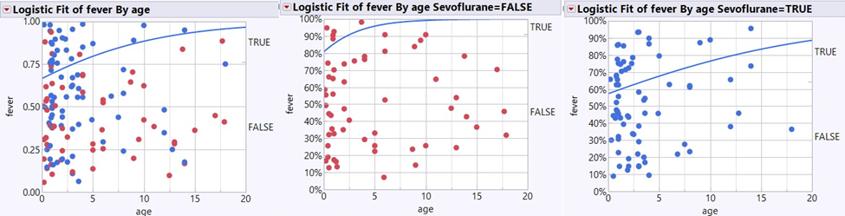
Figure 1a-c: Logistic plot for fever by age.
Discussion
In our retrospective study we found that sedation with Sevoflurane is a significant risk factor for developing fever post FB in children. To the best of our knowledge this is the first study that found this finding. Sevoflurane is a highly fluorinated ether that is in common use for induction of anesthesia or sedation via inhalation. The side effects of Sevoflurane are well known; Brady- or Tachycardia, Hypotension, Seizures, Agitation emergence, Shivering and malignant hyperthermia. However, there is a report about two cases of febrile convulsions in children during the induction [15] without elevation of creatine kinase, i.e. most probably not the same pathophysiological mechanism as in malignant hyperthermia. This finding strengthens the conclusions of previous studies that the fever post FB rises via inflammatory, non-infectious mechanism [10].
Young age found to be also a risk factor for fever post FB in children (Figure 1b), this finding correlates with previously published study [7] that found age younger than 2 years as a risk factor for fever post FB. The reason behind this finding could be the different cell count in BAL in younger children that characterized by higher neutrophil number than in adults, especially in the 1st year [16], this might hint a different inflammatory reaction in infants than in adults.
Another interesting finding was the protective effect of long-term antibiotics (Table 2). This heterogenous group of 25 children was composed mainly from children with recurrent pneumonia or recurrent otitis with no evidence for primary immunodeficiency, most of them treated with Azithromycin but also some with Amoxicillin and Amoxicillin with Clavulanic acid. Hypothetically, if we assume that the pathophysiological mechanism is inflammatory non-infectious, we wouldn’t expect a protective effect from antibiotics. However, this assumption is not correct for those who receive Azithromycin regularly, either 3 times a week or daily dosage. In addition to its anti-bacterial activity, Azithromycin has an additional anti-inflammatory character by reducing Interlukin-8 and Matrix MetalloPeptidase [9]. Moreover, in some other indications, as patients with Cystic Fibrosis colonized with pseudomonas aeruginosa, it is given on daily basis because of its anti-inflammatory effect which lowers the decile in lung function.
There are several limitations to this study which deserve attention. The primary one being that it was performed retrospectively in a single center. In addition, there are confounders that could have biased the results. For instance, given that patients with immunodeficiency were excluded, thus masking the patients that could have developed infection.
Thus overall, Sevufluran has an important role in the appearance of fever post flexible bronchoscopy in children, the mechanism is most probably inflammatory non-infectious. Patient’s work up algorithms should consider elimination of antibiotic treatment in patients with fever post flexible bronchoscopy.
Conclusion
We conclude that fever post bronchoscopy is probably inflammatory non-infectious process. Sevoflurane is a significant risk factor for developing post-bronchoscopy fever by generating such inflammation. Same mechanism also might explain why Montelukst has a protective role.
Declaration of Interest Statement
all authors declare no conflict of interests.
References
- Carlens, J., Fuge, J., Price, T., DeLuca, D. S., Price, M., et al. (2018). Complications and risk factors in pediatric bronchoscopy in a tertiary pediatric respiratory center. Pediatric Pulmonology, 53(5):619-627.
Publisher | Google Scholor - Barbato, A., Magarotto, M., Crivellaro, M., Novello Jr, A., Cracco, A., et al. (1997). Use of the paediatric bronchoscope, flexible and rigid, in 51 European centres. European Respiratory Journal, 10(8):1761-1766.
Publisher | Google Scholor - DeBoer, E. M., Prager, J. D., Kerby, G. S., Stillwell, P. C. (2016). Measuring pediatric bronchoscopy outcomes using an electronic medical record. Annals of the American Thoracic Society, 13(5):678-683.
Publisher | Google Scholor - Hackner, K., Riegler, W., Handzhiev, S., Bauer, R., Veres, J., et al. (2017). Fever after bronchoscopy: serum procalcitonin enables early diagnosis of post-interventional bacterial infection. BMC Pulmonary Medicine, 17(1):156.
Publisher | Google Scholor - Um, S. W., Choi, C. M., Lee, C. T., Kim, Y. W., Han, S. K., et al. (2004). Prospective analysis of clinical characteristics and risk factors of postbronchoscopy fever. Chest, 125(3):945-952.
Publisher | Google Scholor - Mohallem Fonseca, M. T., Camargos, P. A. M., Abou Taam, R., Le Bourgeois, M., Scheinmann, P., et al. (2007). Incidence rate and factors related to post-bronchoalveolar lavage fever in children. Respiration, 74(6):653-658.
Publisher | Google Scholor - Picard, E., Schwartz, S., Goldberg, S., Kerem, E., Glick, T., et al. (2000). A prospective study of fever and bacteremia after flexible fiberoptic bronchoscopy in children. Chest, 117(2):573-577.
Publisher | Google Scholor - Krause, A., Hohberg, B., Heine, F., John, M., Burmester, G. R., et al. (1997). Cytokines derived from alveolar macrophages induce fever after bronchoscopy and bronchoalveolar lavage. American Journal of Respiratory and Critical Care Medicine, 155(5):1793-1797.
Publisher | Google Scholor - Standiford, T. J., Kunkel, S. L., Strieter, R. M. (1991). Elevated serum levels of tumor necrosis factor-α after bronchoscopy and bronchoalveolar lavage. Chest, 99(6):1529-1530.
Publisher | Google Scholor - Picard, E., Goldberg, S., Virgilis, D., Schwartz, S., Raveh, D., et al. (2007). A single dose of dexamethasone to prevent postbronchoscopy fever in children: a randomized placebo-controlled trial. Chest, 131(1):201-205.
Publisher | Google Scholor - Picard, E., Schlesinger, Y., Goldberg, S., Schwartz, S., Kerem, E. (1998). Fatal pneumococcal sepsis following flexible bronchoscopy in an immunocompromised infant. Pediatric Pulmonology, 25(6):390-392.
Publisher | Google Scholor - Yigla, M., Oren, I., Bentur, L., Solomonov, A., Elias, N., et al. (1999). Incidence of bacteraemia following fibreoptic bronchoscopy. European Respiratory Journal, 14(4):789-791.
Publisher | Google Scholor - Kane, R. C., Cohen, M. H., Fossieck Jr, B. E., Tvardzik, A. V. (1975). Absence of bacteremia after fiberoptic bronchoscopy. American Review of Respiratory Disease, 111(1):102-104.
Publisher | Google Scholor - Abulebda, K., Abu-Sultaneh, S., Ahmed, S. S., Moser, E. A., McKinney, R. C., et al. (2017). Intensivist-based deep sedation using propofol for pediatric outpatient flexible bronchoscopy. World Journal of Critical Care Medicine, 6(4):179.
Publisher | Google Scholor - Yano, T., Okubo, S., Naruo, H., Iwasaki, T., Takasaki, M., et al. (2008). Two cases with past and family history of febrile convulsion developed seizure-like movements during sevoflurane anesthesia. Anesthesiology, 109(3):571-571.
Publisher | Google Scholor - Midulla, F., Villani, A., Merolla, R., Bjermer, L., Sandstrom, T., et al. (1995). Bronchoalveolar lavage studies in children without parenchymal lung disease: cellular constituents and protein levels. Pediatric Pulmonology, 20(2):112-118.
Publisher | Google Scholor