

Review Article
Evaluating The Effectiveness of Control and Awareness Strategies to Reduce the Spread of Infectious Diseases in Climate-Change-Affected Areas of Al-Hodeidah
- Hussein Dedy *
Studies and Research Program, Authority of Public AL-Thawra Hospital, Hodeidah City, Yemen.
*Corresponding Author: Hussein Dedy, Studies and Research Program, Authority of Public AL-Thawra Hospital, Hodeidah City, Yemen.
Citation: Dedy H. (2025). Evaluating The Effectiveness of Control and Awareness Strategies to Reduce the Spread of Infectious Diseases in Climate-Change-Affected Areas of Al-Hodeidah, Clinical Case Reports and Studies, BioRes Scientia Publishers. 10(2):1-7. DOI: 10.59657/2837-2565.brs.25.256
Copyright: © 2025 Hussein Dedy, this is an open-access article distributed under the terms of the Creative Commons Attribution License, which permits unrestricted use, distribution, and reproduction in any medium, provided the original author and source are credited.
Received: April 16, 2025 | Accepted: April 30, 2025 | Published: May 07, 2025
Abstract
This study aims to assess the effectiveness of epidemic control measures for infectious diseases, such as vaccination and improved sanitation systems, study lies in providing valuable insights into the correlation between climate change and the outbreak of infectious diseases in Al-Hodeidah. Additionally, it offers recommendations for decision-makers and international organizations working in Yemen’s health sector to enhance intervention strategies in mitigating the risks of infectious disease outbreaks in the governorate years. This study employs a descriptive-analytical and statistical methodology to identify the correlation between climate change and the spread of infectious diseases. Data on infection and mortality rates were obtained from health reports, while climate data, including temperature increases and rainfall patterns, were analyzed. The study examined the average annual temperature to each decade from 1990 to 2024 and evaluating the relationship between climatic change and the prevalence of infectious diseases, including cholera, malaria, and dengue fever. correlation factor was calculated to determine the link between climate variables and disease spread. The study concluded that factors such as climate change, poor healthcare infrastructure, water contamination, environmental shifts, armed conflict in Al Hudaydah, and weak surveillance strategies along with inefficiencies in awareness campaigns have significantly contributed to the continued spread of infectious diseases. The study underscores the urgent need to improve disease control strategies, particularly in surveillance and monitoring, in Al Hudaydah of the spread of infectious diseases requires strengthening healthcare infrastructure, intensifying awareness campaigns, and addressing climate change-related challenges.
Keywords: infectious diseases; climate change; Al Hudaydah
Introduction
Al-Hodeidah, one of Yemen's coastal governorates, experiences a hot and humid climate throughout most of the year, making it highly vulnerable to the impacts of climate change especially outbreaks of diseases that commonly occur during periods of heavy rainfall and high temperatures. The annual increase in temperatures is approximated to be 0.2 - 0.3 degrees Celsius, while seasonally fluctuating rainfall patterns have been exacerbated, as in 2024, with heightened risks of epidemics of malaria, dengue fever, and hepatitis A, leading the Media Office of the Ministry of Health and Environment in Al-Hodeidah and local news reports to indicate that the number of infections and deaths has reached record levels over the past ten years. Cases of Malarial fever in 2015: 513,000 | 2019: 1,100,000, highest peak., 2019 (Al-Hudaydah): 505,200 cases tested, with one death, 2020: 621,365 cases tested, with 5 deaths, 2021: 571,448 cases tested, with 15 deaths, and 2022: 470,846 cases tested, with 8 deaths. Dengue fever in 2019: 25,376 cases with 111 deaths, 2020: Cases increased to 32,007, with 67 deaths, 2021: 8,001 cases recorded, with 13 deaths, 2022: Cases rose to 20,316, with 29 deaths. and 2024: As of September 15, 182 cases recorded, with one death and Cholera in 2017: 77,286 cases, making it one of the most affected years, 2024: Approximately 24,000 to 40,000 cases recorded.
One of the most critical global health issues is climate change, which has significant health impacts, especially in coastal areas like Al-Hodeidah. This underscores the importance of studying the relationship between climate and health to implement effective public health measures. The research problem focuses on evaluating the efficiency of the national strategy for combating infectious diseases and awareness campaigns in reducing the increasing cases of malaria and dengue fever. The significance of this study lies in providing valuable insights into the correlation between climate change and the outbreak of infectious diseases in Al-Hodeidah. Additionally, it offers recommendations for decision-makers and international organizations working in Yemen’s health sector to enhance intervention strategies in mitigating the risks of infectious disease outbreaks in the governorate years. Studies indicate that global warming contributes to the increased spread of infectious diseases such as malaria and dengue fever, as the geographic areas where disease-carrying insects like mosquitoes can thrive expand [1]. Regional climate changes affect human health through alterations in infectious disease patterns, exacerbation of heat-related illnesses, and degradation of air quality [2]. Climate change is expected to increase the frequency and severity of extreme weather events, adversely impacting public health [3]. Climate change is expected to increase the frequency and severity of extreme weather events, adversely impacting public health [4].
Methodology
This study adopts a descriptive analytical approach and statistical analysis, utilizing data from health reports, surveys, and interviews with healthcare workers and residents.
Materials
The materials used in our study included temperature data for the Republic of Yemen and specifically for Al-Hudaydah Governorate over four decades, from 1990 to 2024 obtained from meteorological data from the World Health Organization (WHO) and climate change indicators, including temperature, rainfall, floods, and droughts in Al Hudaydah. The study also included data on infectious diseases associated with climate change and rising temperatures
Methods
methodology involved analyzing climate data obtained from the World Health Organization and local meteorological stations, covering temperature, rainfall, and extreme events in Al-Hodeidah. We calculated analyzed annual temperature averages across each decade from 1990 to 2024 and the correlation between climate changes and the prevalence of infectious diseases, including cholera and malaria, were sourced from international health organizations and the Yemeni Ministry of Public Health. Malaria incident in 2015: 513,000 recorded cases, 2019: 1,100,000 cases, the highest peak., 2019 (Al-Hudaydah): 505,200 cases tested, with one death, 2020: 621,365 cases tested, with 5 deaths, 2021: 571,448 cases tested, with 15 deaths, and 2022: 470,846 cases tested, with 8 deaths. Dengue fever in 2019: 25,376 cases with 111 deaths, 2020: Cases increased to 32,007, with 67 deaths., 2021: 8,001 cases recorded, with 13 deaths, 2022: Cases rose to 20,316, with 29 deaths. and 2024: As of September 15, 182 cases recorded, with one death and Cholera in 2017: 77,286 cases, making it one of the most affected years, 2024: Approximately 24,000 to 40,000 cases recorded.
The cumulative temperature increases across all decades amounted to a 0. 2 - 0. 3°C rise to 2024 compared to previous decades. We also compiled statistics on infectious diseases such as cholera, malaria, dengue fever, and hepatitis A as indicators of the increased Prevalence of infectious diseases in Al-Hodeidah. These statistics were obtained from international organizations working in Yemen, particularly in Al-Hodeidah, and from the Ministry of Public Health in Yemen. We then compared the infectious disease statistics to each decade from 1990 to 2024, in relation to climate change and the surrounding conditions of the population. Temperature and infectious disease data for Al-Hodeidah were obtained from the World Health Organization (WHO) and the Yemeni Ministry of Public Health.
Analysis Data
Impact of Climate Change on Infectious Diseases
Climate change has been linked to the increasing spread of mosquito-borne diseases. Rising temperatures, increased rainfall, and flooding create favorable conditions for mosquito breeding, leading to higher transmission rates of malaria and dengue fever [12].
Temperature Increases: Al-Hodeidah has experienced a steady rise in temperature over the past four decades, with an increase of 0.2 - 0.3 °C each decade. This rise has created favorable conditions for mosquitoes, leading to an increase in diseases such as malaria and dengue fever.
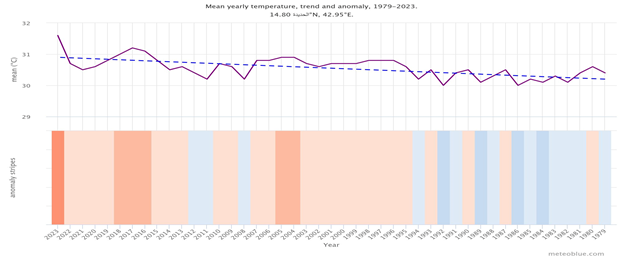
Figure 1: Temperature of 1979 - 2023 in Hodeidah [17].
Increased Flooding: Climate-induced changes in increased rainfall, and flooding, all of which create ideal conditions for mosquito breeding [13].
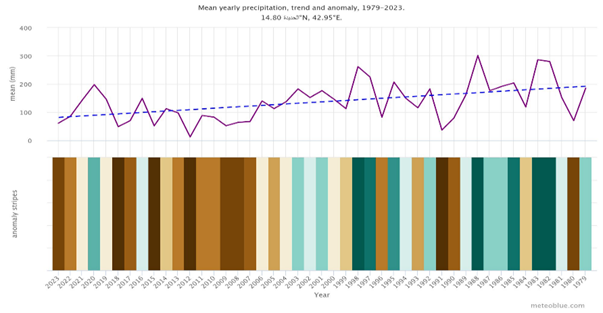
Figure 2: Increased Flooding in Hodeidah of 1979-2023 [17].
Analysis Data Infection Disease
Malaria Prevalence Analysis: in 2015: 513,000 recorded cases, 2019: 1,100,000 cases, the highest peak, 2019 (Al-Hudaydah): 505,200 cases tested, with one death, 2020: 621,365 cases tested, with 5 deaths, 2021: 571,448 cases tested, with 15 deaths and 2022: 470,846 cases tested, with 8 deaths.
Dengue Fever Prevalence Analysis: In 2019: 25,376 cases with 111 deaths, 2020: Cases increased to 32,007, with 67 deaths, 2021: 8,001 cases recorded, with 13 deaths, 2022: Cases rose to 20,316, with 29 deaths and 2024: As of September 15, 182 cases recorded, with one death.

Figure 3: Malaria case and Dangue fever case.
Hepatitis A Virus Prevalence Analysis: There is no specific data available on the spread of Hepatitis A in Al-Hodeidah for the mentioned period.
Cholera Prevalence Analysis: In 2017: 77,286 cases, making it one of the most affected years and 2024: Approximately 24,000 to 40,000 cases recorded.
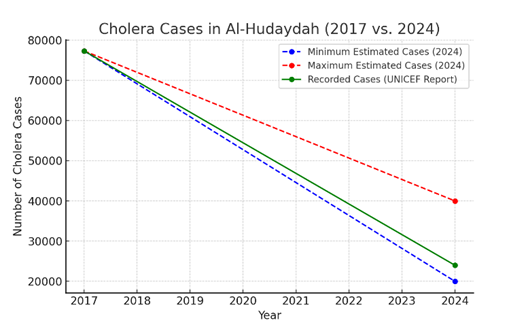
Figure 4: Cholera Case.
Health Descriptive Analytical Assessment
- Strengths Available
- Improved response in some epidemic outbreaks, reducing mortality rates.
- Support from international organizations such as WHO and UNICEF for free vaccination and treatment campaigns.
- Ongoing governmental and NGO efforts to provide medications and conduct mosquito control campaigns.
Weaknesses Available
- Weak healthcare infrastructure, with severe shortages in medical supplies.
- Lack of clean drinking water and sanitation services, increasing waterborne diseases like cholera.
- Delayed response due to ongoing conflict, leading to late treatment and prevention.
- Lack of public health awareness, especially in rural areas.
Opportunities Available
- Strengthening partnerships with international organizations for more funding and technical support.
- Investing in public health education to reduce disease transmission.
- Expanding epidemiological surveillance programs and early diagnosis.
Challenges Experiencing Health Interventions
- Ongoing conflict, restricting access to healthcare services.
- Limited funding, making the healthcare system heavily reliant on humanitarian aid.
- Lack of sustainability in interventions, as efforts are often focused on emergency responses.
Results
Correlation Analysis
Malaria A weak negative correlation with temperature (-0.24) and a strong positive correlation with precipitation (0.88). Dengue Fever A very weak correlation with temperature (0.08) but a strong correlation with precipitation (0.85). Cholera A weak positive correlation with temperature (0.29) and a moderate positive correlation with precipitation (0.76).

ANOVA Test Results: p-values: Less than 0.05 indicate strong relationship between variables: Malaria Temperature: p = 0.0006 strong relationship, Rainfall: p = 0.0020 strong relationship, Dengue Fever Temperature: p = 0.000016 Very strong relationship, Rainfall: p = 0.0022 strong relationship and Cholera Temperature: p = 0.00006 Strong relationship, Rainfall: p = 0.0112 Less strong relationship.
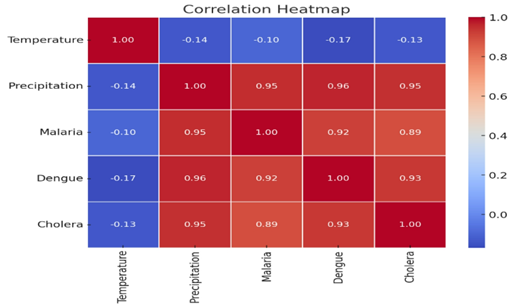
Figure 5: Results.
Displays relationships between temperature, precipitation, and disease prevalence. Malaria and dengue fever are strongly correlated with precipitation, while cholera has a moderate correlation with both climate factors.
Interpretation: There is a strong correlation between temperature and the spread of all three diseases (malaria, dengue fever, and cholera). Rainfall is strongly associated with the spread of malaria and dengue fever but has a weaker association with cholera.
Linear Regression Analysis: Regression models for malaria, dengue fever, and cholera with precipitation and temperature as predictors. Regression plots for each disease [16]. Regression models illustrate how well climate variables predict disease incidence. Precipitation has a stronger predictive power for malaria and dengue fever.

Figure 6: Regression Analysis.
Correlation Heatmap: A visual representation of correlation coefficients for temperature and precipitation with disease incidence.
ANOVA Results: Strong relationships (p-values lessthan 0.05) for all diseases. The p-values are extremely low, confirming a strong influence of climate factors. Strong relationships (p-values lessthan 0.05) for all diseases. The extremely low p-values confirm a strong influence of climate factors.
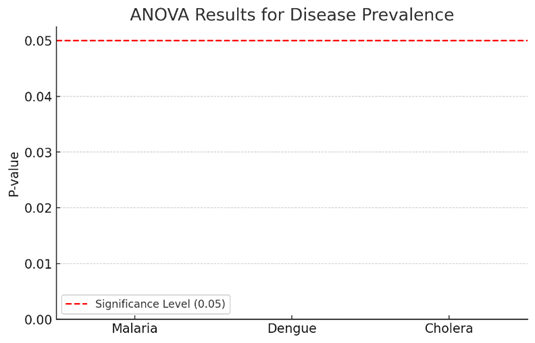
Figure 7: ANOVA Results.
Discussion
Scientific evidence strongly links climate change to the increased incidence of vector- and waterborne diseases. Higher temperatures and humidity levels promote mosquito reproduction, while increased flooding facilitates bacterial contamination of water sources. Al-Hodeidah’s climate, exacerbated by global warming, underscores the need for targeted health interventions. Changes in water temperatures associated with climate change may impact the survival and distribution of Vibrio cholerae in aquatic environments [5]. Climate changes influence the spread of mosquito-borne diseases by affecting the biology and distribution of vectors [6]. Climate change necessitates integrated responses in international public health policies to mitigate its impacts on human health [7]. Floods associated with climate change led to multiple health impacts, including injuries, infectious diseases, and psychological issues [8]. Advanced models help in understanding how climate change affects the spread of mosquito-borne diseases, supporting the development of mitigation and adaptation strategies [9]. Climate factors contributing to increased disease spread include rising temperatures, increased rainfall, and flooding, all of which create ideal conditions for mosquito breeding [13]. The common risk factor was recorded for renal stones and salts patients were dehydration and nutrient that develop to renal failure in the future [16].
Recommendations
- Enhance early warning and disease surveillance systems to enable rapid detection and response.
- Ensure universal access to clean water and proper sanitation to reduce health risks.
- Strengthen vaccination programs and vector control efforts to prevent disease outbreaks.
- Invest in public health education and awareness campaigns to promote preventive measures.
- Expand laboratory capacity and medical field teams to improve early diagnosis and response.
- Upgrade healthcare facilities and ensure a steady supply of medical resources to enhance service delivery.
- Implement long-term preventive strategies focusing on mosquito control and public engagement.
- Improve waste management and hygiene infrastructure to mitigate environmental health hazards.
- Secure sustainable healthcare funding through global partnerships and collaborative initiatives.
Conclusion
This study emphasizes the importance of climate adaptation strategies to mitigate infectious disease risks in Al-Hodeidah. Recommended measures include strengthening local healthcare infrastructure, implementing water purification systems, and raising community awareness about disease prevention. Addressing climate-related health challenges is essential to safeguard public health in Al-Hodeidah. The study highlights the urgent need for improved disease control strategies in Al-Hodeidah. Strengthening health infrastructure, enhancing awareness campaigns, and addressing climate-related challenges are essential to mitigating the spread of infectious diseases in the region. The health situation analysis in Al-Hudaydah Governorate indicates that epidemic diseases remain a major challenge despite some improvements in mortality rates. However, significant challenges persist, requiring effective and sustainable interventions. By strengthening health infrastructure, improving epidemiological surveillance, and increasing public health awareness, the burden of epidemic diseases can be significantly reduced, ensuring better health outcomes for the local population.
Declarations
Ethical Approval
The title of the study explicitly states that it was conducted under the Research and Studies program at Al-Thawra General Hospital – Al-Hodeidah, indicating that the study was approved by the relevant authority.
Informed Consent
The study did not involve direct experiments on participants or data collection through interviews or surveys. Instead, it relied solely on data extracted from medical records. Therefore, obtaining informed consent from individuals was not required.
Research Interview
No research interviews were conducted since the study was based on analyzing previously recorded data. As a result, there is no supplementary document related to research interview questions.
Compliance with the Declaration of Helsinki
The study adhered to all ethical guidelines in accordance with the Declaration of Helsinki, ensuring data confidentiality and use strictly for research purposes.
Data Availability
A statement regarding data availability has been included in compliance with the journal’s policies.
Competing Interests
The authors declare that they have no competing interests.
Funding
This research received no specific grant from any funding agency in the public, commercial, or not-for-profit sectors.
Acknowledgement
The authors would like to acknowledge the support of the National Blood Transfusion and Research Center and AL-Thawra Hospital, Hodeidah City, Yemen for providing valuable data and insights relevant to this study.
References
- Githeko, A. K., Lindsay, S. W., Confalonieri, U. E., Patz, J. A. (2000). Climate Change and Vector-Borne Diseases: A Regional Analysis. Bulletin of the World Health Organization, 78(9):1136-1147.
Publisher | Google Scholor - Patz, J. A., Campbell-Lendrum, D., Holloway, T., Foley, J. A. (2005). Impact of Regional Climate Change on Human Health. Nature, 438(7066):310-317.
Publisher | Google Scholor - McMichael, A. J. (Ed.). (2003). Climate change and human health: risks and responses. World Health Organization.
Publisher | Google Scholor - Confalonieri, U., Menne, B., Beggs, P., Akhtar, R., Ebi, K. L., et al. (2007). Human Health. In Climate Change 2007: Impacts, Adaptation and Vulnerability. Cambridge University Press (CUP). 391-431.
Publisher | Google Scholor - Lipp, E. K., Huq, A., Colwell, R. R. (2002). Effects of Global Climate on Infectious Disease: The Cholera Model. Clinical Microbiology Reviews, 15(4):757-770.
Publisher | Google Scholor - Reiter, P. (2001). Climate Change and Mosquito-Borne Disease. Environmental Health Perspectives, 109(suppl 1):141-161.
Publisher | Google Scholor - Campbell-Lendrum, D., Corvalán, C., Neira, M. (2007). Global Climate Change: Implications for International Public Health Policy. Bulletin of the World Health Organization, 85(3):235-237.
Publisher | Google Scholor - Few, R., Ahern, M., Matthies, F., Kovats, S. (2004). Floods, Health and Climate Change: A Strategic Review.
Publisher | Google Scholor - Tjaden, N. B., Caminade, C., Beierkuhnlein, C., Thomas, S. M. (2018). Mosquito-Borne Diseases: Advances in Modelling Climate-Change Impacts. Trends in Parasitology, 34(3):227-245.
Publisher | Google Scholor - World Health Organization
Publisher | Google Scholor - https://www.who.int/data/gho/whs-annex
Publisher | Google Scholor - World Health Organization (2024). Climate Change and Health Risks.
Publisher | Google Scholor - WHO EMRO (2024). Regional Report on Infectious Diseases in Yemen.
Publisher | Google Scholor - Althawrah Newspaper (2019, 2022). Health Reports on Malaria and Dengue in Al-Hodeidah.
Publisher | Google Scholor - Yemen Future News (2024). Recent Updates on Dengue Fever Cases in Yemen.
Publisher | Google Scholor - Al-Kamarany, M. A., Al-Osimi, M., Ogaili, M., Majam, S. (2013). Renal Stones among Adult of Hodeidah as Subtropical Region in Yemen: Prevalence, Risk Factors and Common Medication Used. British Biomedical Bulletin.
Publisher | Google Scholor