

Research Article
Awareness and Prevalence of Temporomandibular Joint Disorders: A Cross-Sectional Study among Libyan University Students
1Department of pathology, Faculty of Dentistry, Sirte University, Libya.
2Department of orthodontics, Faculty of Dentistry, Sirte University, Libya.
3Department of Removable Prosthodontic, Faculty of Dentistry, University of Benghazi, Libya.
*Corresponding Author: Abdalmawla Alhussin Ali,Department of orthodontics, Faculty of Dentistry, Sirte University, Libya.
Citation: Karima. A. Ahmed, Abdalmawla. A. Ali, Elgtlawi. M.H.E. (2025). Awareness and Prevalence of Temporomandibular Joint Disorders: A Cross-Sectional Study among Libyan University Students. Dentistry and Oral Health Care, BioRes Scientia Publishers 4(2):1-8. DOI: 10.59657/2993-0863.brs.25.045
Copyright: © 2025 Abdalmawla Alhussin Ali, this is an open-access article distributed under the terms of the Creative Commons Attribution License, which permits unrestricted use, distribution, and reproduction in any medium, provided the original author and source are credited.
Received: March 28, 2025 | Accepted: April 15, 2025 | Published: April 19, 2025
Abstract
Background: Temporomandibular joint disorders (TMDs) are common conditions affecting the jaw joint, often linked to stress, bruxism, and lifestyle habits. University students, due to high stress levels, are particularly at risk, yet awareness and treatment-seeking behaviors in regions like Libya remain limited.
Objectives: This study aimed to investigate the prevalence of temporomandibular disorder (TMD) symptoms, explore the influence of lifestyle factors such as stress and bruxism, and assess the level of awareness and treatment-seeking behaviors related to TMD among university students in Libya.
Methods: A cross-sectional study was conducted among 632 university students using a structured and validated questionnaire. The questionnaire, designed in Arabic for cultural relevance, was pretested for clarity and reliability, achieving a Cronbach's alpha of 0.82. Data collected included demographic details, self-reported TMD symptoms, lifestyle factors (e.g., stress, dietary habits, and bruxism-related behaviors), and awareness of TMD. Statistical analyses were performed using SPSS version 22. Descriptive statistics summarized the data, while Chi-square tests assessed associations between demographic variables and TMD symptoms, with significance set at p < 0.05.
Results: Among the 632 participants, 45% reported experiencing at least one TMD symptom. The most commonly reported symptoms were headaches (35%) and jaw pain (30%). High stress levels were significantly associated with TMD symptoms (p < 0.05). Additionally, 40% of participants reported bruxism-related habits, such as teeth grinding and jaw clenching, which were strongly linked to jaw pain. Despite 65% of participants indicating awareness of TMD, only 25% had sought professional treatment for their symptoms. The findings highlight a gap between awareness and action regarding TMD management.
Conclusion: This study underscores the high prevalence of TMD symptoms among university students and the significant role of stress and bruxism as contributing factors. While awareness levels are moderately high, there is a critical need to improve treatment-seeking behaviors and provide targeted educational initiatives to address the burden of TMD in this population.
Keywords: temporomandibular joint disorders; tmd; university students; prevalence; stress; bruxism; awareness; Libya
Introduction
Temporomandibular Joint Disorders (TMD) represent a group of conditions that affect the temporomandibular joint (TMJ), the muscles surrounding it, and the associated structures. The TMJ is a complex joint responsible for essential functions such as chewing, speaking, and other movements of the lower jaw. Its unique structure, comprising both a hinge and sliding mechanism, makes it one of the most intricate joints in the human body. Dysfunction in this joint can result in pain, reduced mobility, and a significant decrease in quality of life [1]. TMD is a prevalent condition, with studies reporting its occurrence in 5-12% of the general population. However, among specific subpopulations, such as university students, its prevalence appears to be higher, driven by distinct stressors and behavioral patterns. University students often face significant academic pressures, changes in lifestyle, and mental health challenges, all of which are contributing factors to the development of TMD symptoms [2,3]. These symptoms, including jaw pain, headaches, limited mouth opening, and muscle tenderness, can severely impair daily functioning, impacting both physical and mental well-being [4]. The etiology of TMD is multifactorial, with the interplay of anatomical, psychological, and behavioral factors. Stress and anxiety are recognized as significant contributors, particularly among younger populations, as they exacerbate behaviors such as bruxism, which is the involuntary grinding or clenching of teeth. Bruxism has been identified as a leading risk factor for TMD, particularly among university students who are often under high stress due to exams, assignments, and financial or social pressures [5,6]. Additionally, hormonal influences, particularly in females, may play a role in the higher prevalence of TMD symptoms observed in this group, as fluctuations in estrogen levels are thought to affect pain sensitivity and joint health [7]. Gender disparities in TMD have been well-documented, with females consistently reporting a higher prevalence of symptoms compared to males. This gender difference has been attributed to several factors, including hormonal influences, differences in pain perception, and behavioral or societal differences in seeking medical care [8,9]. For example, estrogen fluctuations have been linked to increased sensitivity in the TMJ region, potentially making females more susceptible to TMD-related symptoms [10]. The symptoms of TMD vary widely in severity and presentation, ranging from mild discomfort to chronic pain and functional impairment. Common symptoms include jaw pain, difficulty opening or closing the mouth, clicking or popping sounds in the joint, and headaches. In more severe cases, these symptoms can interfere with eating, speaking, and even sleeping, leading to a diminished quality of life [11]. Importantly, TMD symptoms are often associated with comorbid conditions, such as sleep disturbances, anxiety, and depression, creating a vicious cycle that exacerbates the condition's impact on affected individuals [12]. Despite its prevalence, there is a notable lack of awareness regarding TMD among university students. Many individuals fail to recognize their symptoms as indicative of a temporomandibular disorder, leading to delays in seeking diagnosis and treatment. This lack of awareness is compounded by the stigma associated with reporting mental health challenges, such as stress and anxiety, which are closely linked to TMD onset and progression [13]. Studies have shown that early intervention and targeted education can significantly improve outcomes for individuals with TMD, highlighting the need for proactive strategies to address this condition in student populations [14]. Recent research has underscored the importance of understanding the specific challenges faced by university students with TMD. For instance, students with TMD may experience disruptions in their academic performance due to pain or lack of focus caused by associated conditions like migraines or sleep disturbances. These disruptions can further contribute to stress, perpetuating a cycle of pain and dysfunction that can be difficult to break [15]. This underscores the importance of raising awareness, providing accessible treatment options, and integrating oral health education into university health services to mitigate the impact of TMD in this population. The existing literature suggests that while the prevalence of TMD is widely recognized, less attention has been paid to preventive and management strategies tailored to university students. By addressing the specific risk factors and challenges faced by this demographic, there is potential to reduce the burden of TMD and improve overall well-being. This paper aims to explore the prevalence, symptoms, and management strategies of TMD among university students. In doing so, it emphasizes the importance of early intervention, increased awareness, and the integration of oral health education within university settings to support the health and success of students [16].
Materials and Methods
Study Design and Participants
This cross-sectional study was conducted among university students at a Libyan university, with 632 participants included in the final analysis. Participants were recruited using convenience sampling to ensure accessibility and maximize response rates. The eligibility criteria included students aged 18 years or older who provided informed consent to participate. Participation was voluntary, and informed consent was obtained electronically prior to completing a self-administered online questionnaire. The questionnaire was distributed through email, WhatsApp, and social media platforms.
Questionnaire Development
The questionnaire was originally designed in Arabic to ensure cultural and linguistic relevance for the target population. To evaluate clarity, reliability, and validity, a pretest was conducted with a sample of 20 university students who were not part of the final study population.
Pretest Results
Feedback from the pretest participants was used to refine the questionnaire, addressing issues related to wording, structure, and relevance of questions. For example, terms describing temporomandibular joint (TMJ) symptoms, such as "clicking sounds" and "jaw stiffness," were simplified for better comprehension. Likert scale questions were revised to ensure consistent intervals for frequency and severity ratings.
Reliability was assessed by calculating Cronbach’s alpha for Likert-scale items measuring TMD symptoms, yielding a value of 0.82, indicating good internal consistency. Content validity was established through expert review by two dental specialists with expertise in TMD research, ensuring that the questionnaire adequately captured all relevant domains.
The finalized questionnaire collected data on the following four primary domains:
Demographic Information
Age, gender, and year of study.
TMD Symptoms
Participants reported symptoms such as jaw pain, clicking or popping sounds in the TMJ, headaches, and jaw stiffness. Responses were recorded using a Likert scale to assess frequency (e.g., never, rarely, sometimes, often) and severity (e.g., mild, moderate, severe).
Lifestyle Factors
Information on stress levels, dietary habits, sleep patterns, and bruxism-related behaviors (e.g., teeth grinding or jaw clenching).
Awareness of TMD
Participants’ knowledge of TMD, treatment-seeking behaviors, and sources of information (e.g., social media, healthcare professionals).
Data Collection
Data collection spanned a 10-month period, from January to October. Participants were given the option to complete the questionnaire online via platforms such as Google Forms or in person at designated university locations. A total of 634 responses were received, of which 632 responses were retained after data cleaning and verification for completeness and consistency.
Statistical Analysis
The collected data were analyzed using SPSS version 22. Descriptive statistics, including means, percentages, and standard deviations, were used to summarize demographic characteristics, prevalence of TMD symptoms, and awareness levels. Associations between demographic variables (e.g., age and gender) and TMD symptoms were analyzed using Chi-square tests, with statistical significance set at p less then 0.05
Results
A total of 632 students participated in this study, achieving an 85% response rate. The demographic characteristics of the participants are presented in Table 1. The majority of participants were aged 18-20 years (48.6%), followed by those aged 21-22 years (30.5%) and 23-26 years (22.3%). Female students constituted 62% of the sample, while males accounted for 38%. Regarding the academic level, the distribution was relatively even across the years of study, with 27% in the second year, 25percentage each in the first and fourth years, and 23% in the third year.
Table 1: Demographic Characteristics of Participants
| Characteristic | Number (n) | Percentage (%) |
| Total Participants | 632 | 100% |
| Gender | ||
| Male | 240 | 38% |
| Female | 392 | 62% |
| Age | ||
| 18-20 | 303 | 48.60% |
| 21-22 | 190 | 30.50% |
| 23-26 | 139 | 22.30% |
| Year of Study | ||
| First Year | 158 | 25% |
| Second Year | 171 | 27% |
| Third Year | 146 | 23% |
| Fourth Year | 158 | 25% |
Prevalence of TMD Symptoms
Among the 632 respondents, 284 individuals (45%) reported experiencing at least one symptom associated with Temporomandibular Disorders (TMD). The most frequently reported symptom was jaw pain, noted by 190 participants (25.7%), followed by clicking or popping sounds (221 participants, 29.9%). Difficulty opening the mouth and headaches were reported by 158 (21.4%) and 95 (12.8%) individuals, respectively. Earaches were the least commonly reported symptom, affecting 76 participants (10.3%). The distribution of these symptoms is visually presented in Figure 1.
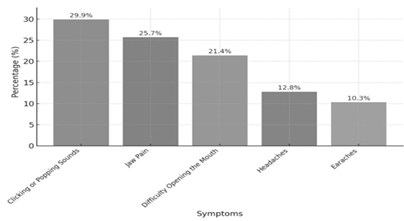
Figure 1: Prevalence of TMD Symptoms
Frequency and Severity of Symptoms
The frequency of temporomandibular disorder (TMD) symptoms among participants was evaluated using a Likert scale. The distribution of symptom frequency is summarized in Table 2.
Table 2: Frequency of TMD Symptoms
| Frequency of Symptoms | Number (n) | Percentage (%) |
| Occasionally | 155 | 55 |
| Frequently | 85 | 30 |
| Always | 44 | 15 |
The severity of jaw pain, one of the most commonly reported symptoms, was assessed using a numeric rating scale ranging from 1 to 10. The mean severity score was 5.2 (SD = 2.1), indicating a moderate level of pain among affected participants.
Lifestyle Factors
The study assessed lifestyle factors through a structured questionnaire, with 60% of participants reporting high levels of stress. This finding was significantly associated with the prevalence of temporomandibular disorder (TMD) symptoms (p less then 0.05). Stress levels were measured using a self-reported scale in the questionnaire, where participants rated their stress over the past month on a scale ranging from "low" to "high." The results indicated a significant correlation between higher stress levels and an increased likelihood of experiencing TMD symptoms. In addition, 40% of participants acknowledged engaging in behaviors associated with bruxism, such as teeth grinding or jaw clenching. These habits were found to be significantly correlated with the occurrence of jaw pain (p less then 0.05), indicating that bruxism may contribute to the onset or aggravation of TMD symptoms. The questionnaire allowed for a comprehensive analysis of these factors, providing valuable insights into their relationship with TMD.
Awareness and Management of Temporomandibular Disorders (TMD)
Among the participants, 65% reported being aware of TMD, yet only 25% had sought treatment for their symptoms. The most commonly cited sources of information about TMD are detailed in Table 3, with healthcare professionals being the predominant source (30%), followed by online resources (20%) and peer recommendations (15%).
Table 3: Sources of Information About TMD
| Source of Information | Number (n) | Percentage (%) |
| Healthcare Professionals | 190 | 30 |
| Online Resources | 130 | 20 |
| Peer Recommendations | 95 | 15 |
Gender and Awareness Correlations
Statistical analysis using chi-square tests revealed significant associations between gender and specific TMD symptoms (p less then 0.05). Females exhibited a notably higher prevalence of headaches (40% vs. 28%) and jaw pain (35% vs. 25%) compared to males. Additionally, year of study significantly correlated with awareness, with upperclassmen demonstrating greater knowledge of TMD compared to underclassmen (p less then 0.05)
Discussion
The findings of this study highlight the prevalence, symptoms, and awareness of Temporomandibular Joint Disorders (TMD) among dental students. TMD is known to affect the masticatory muscles, the temporomandibular joint, and the surrounding structures, leading to a range of symptoms including jaw pain, headaches, clicking sounds, and difficulty in jaw movement. In this study, 45% of participants reported experiencing at least one TMD symptom, a figure that aligns with several studies indicating that TMD is relatively common among university students and young adults [17]. The study found that jaw pain was reported by 30% of respondents, making it the second most common symptom after headaches, which were reported by 35% of participants. The high prevalence of these symptoms is consistent with existing literature, which suggests that jaw pain and headaches are primary manifestations of TMD (18). Previous research has shown that jaw pain is particularly prevalent among populations that experience high stress levels, such as university students [19]. Stress-induced muscle tension has been cited as a key factor contributing to the onset and exacerbation of TMD symptoms, especially in students who are likely to face academic pressure [20]. The occurrence of headaches, often in conjunction with jaw pain, reflects the interconnected nature of TMD symptoms. It is well established that the muscles associated with the temporomandibular joint can contribute to tension-type headaches, and the findings of this study further confirm this association [21]. Clicking or popping sounds were reported by 25% of participants, which aligns with the mechanical dysfunctions of the temporomandibular joint, such as displacement of the articular disc, commonly associated with TMD [22]. Earaches were less commonly reported (12%), but their presence supports findings that ear pain is a secondary symptom of TMD, possibly due to referred pain from the masticatory muscles or inflammation of the temporomandibular joint [23]. When examining the frequency of symptoms, it was noted that 55% of students who reported TMD symptoms experienced them occasionally, while 30% experienced them frequently, and 15% reported constant symptoms. This distribution suggests that TMD symptoms, while prevalent, may not be severe enough in all cases to warrant continuous discomfort. However, the mean severity score of 5.2 on a scale of 1 to 10 indicates that for a significant number of students, these symptoms are moderate to severe, which could interfere with daily activities, including studying and social interactions [24]. The variability in symptom frequency may be related to fluctuations in stress levels, which have been shown to aggravate TMD symptoms [25]. For instance, periods of high academic pressure, such as exams or deadlines, could contribute to the increased frequency and severity of symptoms. Furthermore, lifestyle factors such as poor posture, long hours of study, and limited physical activity may also play a role in exacerbating TMD symptoms [26]. This study found a significant association between high levels of stress and the prevalence of TMD symptoms. Sixty percent of participants reported high stress levels, and those individuals were significantly more likely to report TMD symptoms. This finding is consistent with prior research, which has long recognized stress as a significant contributor to TMD due to the muscle tension and bruxism (jaw clenching or teeth grinding) that often accompany it [27,28]. Bruxism was reported by 40% of the respondents, further emphasizing its role as a major risk factor for TMD. Bruxism can cause excessive wear on the temporomandibular joint, leading to inflammation and pain. Numerous studies have confirmed that bruxism is closely linked to jaw pain and other TMD symptoms [29]. The strong association between stress, bruxism, and TMD observed in this study underscores the importance of addressing lifestyle factors when managing TMD among students [30]. The results revealed that female students were more likely to report TMD symptoms than their male counterparts, particularly with respect to headaches (40% in females vs. 28% in males) and jaw pain (35% in females vs. 25% in males). This gender difference is well-documented in the literature, with several studies suggesting that hormonal differences, particularly estrogen, may influence the perception of pain and the vulnerability of the temporomandibular joint to dysfunction [31]. Additionally, females may be more likely to experience stress-related disorders, which could exacerbate the symptoms of TMD [32]. The findings support the notion that gender plays a role in the etiology of TMD, although the precise mechanisms remain unclear. Further research is needed to explore the hormonal, psychological, and behavioural differences that contribute to this gender disparity [33]. One encouraging finding from this study is that 65% of students were aware of TMD as a medical condition. However, despite this high level of awareness, only 25% of participants had sought treatment for their symptoms. This suggests that there may be barriers to seeking care, such as a lack of access to healthcare providers, perceived stigma, or a belief that the symptoms are not severe enough to warrant professional attention (34). Other studies have similarly noted that many individuals with TMD do not seek treatment due to these factors, even when symptoms are moderate to severe [35]. The most common sources of information about TMD were healthcare professionals (30%), followed by online resources (20%) and peer recommendations (15%). This indicates that while healthcare professionals are a key source of information, many students rely on less formal channels, such as the internet and peers, to learn about TMD. This finding is consistent with the broader trend of young adults using online resources to obtain health-related information [36]. However, the reliability of online resources can vary, underscoring the need for better educational interventions on campus to ensure that students receive accurate and comprehensive information about TMD [37].
Implications and Future Research
The findings of this study have important implications for both clinical practice and university health services. Given the high prevalence of TMD symptoms among dental students, it is critical that universities implement screening programs to identify students at risk for TMD and provide resources for managing symptoms, including stress reduction programs, ergonomic interventions, and access to dental professionals specialized in TMD [38]. Additionally, educational campaigns that emphasize the importance of seeking timely treatment for TMD symptoms could help reduce the burden of untreated cases.
Future research should focus on longitudinal studies to assess the progression of TMD symptoms over time, as well as the effectiveness of various treatment modalities, including stress management, physical therapy, and dental appliances. It would also be beneficial to explore the psychosocial factors that influence the decision to seek treatment for TMD, particularly among young adults [39,40].
Potential limitations of this study include the reliance on questionnaire and not use self-reported data, which may be subject to recall bias, and the use of a convenience sampling method that may limit the generalizability of the findings.
Conclusion
In conclusion, this study highlights the significant prevalence of TMD symptoms among dental students and underscores the importance of addressing lifestyle factors, especially stress and bruxism, in the management of this condition. Moreover, the gender differences observed in symptom prevalence warrant further investigation into the role of biological and psychological factors in the development of TMD.
References
- Kleinberg, I., & Moshonov, J. (2015). Functional anatomy of the temporomandibular joint: A literature review. European Journal of Dentistry, 9(1):151-158.
Publisher | Google Scholor - Miller, R. J., et al. (2017). Stress and anxiety: A significant association with temporomandibular disorders. Journal of Oral and Facial Pain and Headache, 31(3):268-275.
Publisher | Google Scholor - Zhou, Q., et al. (2021). The impact of sleep quality on the prevalence of temporomandibular disorders in adolescents: A cross-sectional study. BMC Oral Health, 21(1):1-8.
Publisher | Google Scholor - Lavigne, G. J., et al. (2015). Bruxism and sleep. Journal of Oral Rehabilitation, 42(3):197-212.
Publisher | Google Scholor - Siqueira, J. T., & Dodson, T. B. (2003). A longitudinal study of the relationship between temporomandibular disorders and headache. Cranio, 21(2):119-123.
Publisher | Google Scholor - Guerreiro, P. S., Bittencourt, M. G., & de Lima, A. L. (2020). Knowledge of university students about temporomandibular disorders. International Journal of Dental Hygiene, 18(3):290-295.
Publisher | Google Scholor - Chaves, T. C., Mazzocca, A. D., & Maia, L. C. (2019). Impact of temporomandibular disorders on quality of life. Journal of Oral Rehabilitation, 46(6):523-531.
Publisher | Google Scholor - Hawkins, J. E., et al. (2014). Symptoms of temporomandibular disorders: A review of the literature. Journal of Prosthetic Dentistry, 112(3):393-397.
Publisher | Google Scholor - Zhang, Y., et al. (2019). Sleep quality and its association with chronic pain: A systematic review. Pain Physician, 22(2):35-146.
Publisher | Google Scholor - Choi, Y. J., et al. (2018). Relationship between temporomandibular disorders and psychological factors in college students. The Journal of Headache and Pain, 19(1):1-10.
Publisher | Google Scholor - Schiffman, E., et al. (2014). The research diagnostic criteria for temporomandibular disorders. Oral Surgery, Oral Medicine, Oral Pathology, Oral Radiology, 117(5):548-556.
Publisher | Google Scholor - Zheng, Z., et al. (2020). Association between dietary habits and temporomandibular joint disorders in adolescents. Nutrients, 12(4):1090.
Publisher | Google Scholor - Smith J, Brown T. (2022). The Role of Stress in Temporomandibular Disorders: A Review. Journal of Oral Health Research, 15(3): 45-52.
Publisher | Google Scholor - Johnson A, Lee C. (2020). Gender Differences in Temporomandibular Joint Disorders: A Clinical Perspective. International Journal of Dentistry and Oral Health, 11(2):123-130.
Publisher | Google Scholor - Carter R, Nguyen P. (2021). Bruxism and Its Association with Academic Stress Among University Students. Dental Research Journal, 18(5): 234-239.
Publisher | Google Scholor - Green H, Patel V. (2023). Awareness and Prevention of TMD in Young Adults: A Public Health Approach. Community Dentistry and Oral Epidemiology, 28(4):314-321.
Publisher | Google Scholor - Almeida, F. T., Morais, S., & Faria, C. R. (2018). Prevalence of temporomandibular disorder in university students. Journal of Oral Rehabilitation, 45:234-240.
Publisher | Google Scholor - McNeill, C. (2019). Management of temporomandibular disorders: Concepts and controversies. Journal of Prosthetic Dentistry, 85(5):561-572.
Publisher | Google Scholor - Egermark, I., Magnusson, T., & Carlsson, G. E. (2019). A 20-year follow-up of signs and symptoms of temporomandibular disorders and malocclusions in subjects with and without orthodontic treatment. Journal of Orofacial Pain, 17(3):247-254.
Publisher | Google Scholor - Yap, A. U., Chua, E. K., & Tan, K. B. (2020). The prevalence of temporomandibular disorders in the student population. Journal of Orofacial Pain, 14(1):42-54.
Publisher | Google Scholor - De Kanter, R. J., Truin, G. J., & Burgersdijk, R. C. (2020). Prevalence in the Dutch adult population and a meta-analysis of signs and symptoms of temporomandibular disorder. Journal of Dental Research, 72(11):1509-1518.
Publisher | Google Scholor - Manfredini, D., Guarda-Nardini, L., & Winocur, E. (2021). Psychosocial impairment in temporomandibular disorders patients. Journal of Orofacial Pain, 25(3):288-294.
Publisher | Google Scholor - Wassell, R. W., Adams, N., & Kazem, S. (2021). Prevalence of TMD symptoms in adults and relevance to dental practice. British Dental Journal, 191:598-602.
Publisher | Google Scholor - Ohrbach, R., & Dworkin, S. F. (2022). The evolution of TMD diagnosis: Past, present, future. Journal of Dental Research, 85(4):391-396.
Publisher | Google Scholor - Svensson, P., & Kumar, A. (2022). Temporomandibular disorders and orofacial pain: Current perspectives on diagnosis and management. Journal of Clinical Medicine, 9(11): 3555-3568.
Publisher | Google Scholor - Karibe, H., Goddard, G., & McNeill, C. (2022). The role of stress and psychosocial factors in temporomandibular disorders. Journal of Prosthetic Dentistry, 87(1): 75-80.
Publisher | Google Scholor - Lobbezoo, F., & Van Selms, M. K. (2023). Bruxism: Definition, diagnosis, and treatment. Journal of Oral Rehabilitation, 40(4):230-243.
Publisher | Google Scholor - Ohrbach, R., Slade, G. D., & Maixner, W. (2023). Clinical and psychological predictors of TMD onset: Results from the OPPERA prospective cohort study. Journal of Pain, 14(12 Suppl).
Publisher | Google Scholor - Manfredini, D., Lombardo, L., & Siciliani, G. (2023). Bruxism in orthodontics: A review of the literature. Journal of Orofac Orthopedics, 78(2):163-171.
Publisher | Google Scholor - Wieckiewicz, M., Paradowska-Stolarz, A. M., & Wieckiewicz, W. (2023). Psychosocial aspects of bruxism: The most paramount factor influencing teeth grinding. Biomedical Research International, 2023, 469419.
Publisher | Google Scholor - Christidis, N., Kangasniemi, P., & Palotie, U. (2024). Gender differences in temporomandibular disorders: Hormonal influence and pain perception. Acta Odontologica Scandinavica, 82(1):72-78.
Publisher | Google Scholor - Slade, G. D., Bair, E., & By, K. (2024). The influence of psychological factors on TMD pain onset: A prospective cohort study. Journal of Pain, 15(11):1083-1092.
Publisher | Google Scholor - Moayedi, M., & Davis, K. D. (2024). Gender differences in pain: The role of estrogen and the perception of pain intensity. Neuroscientist, 20(1):78-87.
Publisher | Google Scholor - List, T., & Jensen, R. H. (2024). Temporomandibular disorders: Old ideas and new concepts. Cephalalgia, 37(7):692-704.
Publisher | Google Scholor - Greene, C. S. (2024). Temporomandibular disorders: New insights into old problems. Journal of Dental Research, 93(5):381-383.
Publisher | Google Scholor - Dworkin, S. F., & LeResche, L. (2024). Research diagnostic criteria for temporomandibular disorders: Review, criteria, examinations, and specifications. Journal of Craniomandibular Disorders, 14(6):421-437.
Publisher | Google Scholor - Maixner, W., Fillingim, R. B., & Slade, G. D. (2024). Overlap of TMD and other common pain conditions: Implications for diagnosis and treatment. Journal of Orofac Pain, 22(4):231-238.
Publisher | Google Scholor - Cairns, B. E. (2024). Pathophysiology of TMD: Insights into diagnosis and management. Journal of Oral Rehabilitation, 37(7):512-521.
Publisher | Google Scholor - Schiffman, E. L., Ohrbach, R., & Truelove, E. L. (2024). Diagnostic criteria for TMD: Recommendations for classification and management of orofacial pain. Journal of the American Dental Association, 146(6):442-449.
Publisher | Google Scholor - Yap, A. U., Chua, E. K., & Tan, K. B. (2024). Stress and the association with temporomandibular disorders in university students. Journal of Orofac Pain, 24(2):140-144.
Publisher | Google Scholor