

Case Report
Appendico-Ileal Knotting a Rare Cause of Small Bowel Obstruction; Case Report and Literature Review from Leku General Hospital, Ethiopia
1 Leku general Hospital department of Emergency Surgery, Ethiopia.
2 Leku general hospital department of Anesthesia, Ethiopia.
3 Leku general hospital department of general surgery, Ethiopia.
*Corresponding Author: Asfaw Kibret, Leku general Hospital department of Emergency Surgery, Ethiopia.
Citation: Kibret A, Ameno T., Asres M. (2025). Appendico-Ileal Knotting a Rare Cause of Small Bowel Obstruction; Case Report and Literature Review from Leku General Hospital, Ethiopia, Journal of BioMed Research and Reports, BioRes Scientia Publishers. 9(1):1-4. DOI: 10.59657/2837-4681.brs.25.212
Copyright: © 2025 Asfaw Kibret, this is an open-access article distributed under the terms of the Creative Commons Attribution License, which permits unrestricted use, distribution, and reproduction in any medium, provided the original author and source are credited.
Received: October 14, 2025 | Accepted: October 28, 2025 | Published: November 04, 2025
Abstract
Small bowel obstruction is the common cause of acute abdomen for which emergency surgical intervention is mandatory. Bowel knotting’s like Ile sigmoid knotting, ileoileal knotting, ileocecal knotting and appendicoileal knotting’s are rare occurrences as a cause of obstruction. Among these appendicoileal knotting is by far the rarest cause of obstruction. Since its 1st report in 1901, there are case reports of this scenario but all associated it with the presence of appendicitis. We report a 28yrs old female patient who presented with sign symptom of small bowel obstruction for whom appendices-ileal knotting is identified with healthy looking appendix rapped around the distal ileum which was a near miss bowel segment which later returned healthy after the appendix release and warm saline socked sterile pack rapped for a minute. Appendicula knotting can occur in the absence of preceding appendicitis.
Keywords: bowel obstruction; appendicitis; appendicoileal knotting; double loop obstruction; intraoperative surprise
Introduction
Bowel obstruction in general is common cause for acute abdomen which most of the time needs emergency surgical intervention. Small bowel obstruction is the commonest cause worldwide. There are a lot of causes of small bowel obstruction [1,2]. Post-operative adhesion, hernia and malignancies are the commonest causes to mention worldwide. But small bowel volvulus is the commonest in most part of our country Ethiopia. Bowel knotting like, ileosigmoid, ileoileal, ileocecal and appendicoileal are rare causes of bowel obstruction [12]. Among these appendicoileal knotting is the rarest to be occurred in bowel obstruction [3,4]. Since 1901 of the 1st documented report there are few handfuls of cases reported in literatures [13]. Appendicoileal knotting is rapping of the appendex over the segment of distal ileum which causes closed loop obstruction. If untreated or delayed, it results in bowel vascular compromise and eventual bowel ischemia. Preoperative diagnosis is challenging since it has no pathognomonic features but mimic other intestinal obstruction causes of clinical presentations. Preoperative imaging, including computed tomography (CT), has shown potential utility, but its accuracy is limited and in resource limited setups its accessibility is ambitious [6,7].
This case report adds another literature asset to the existing handful of cases world-wide with some peculiarities of un inflamed appendix causing appendico-ileal knotting in 28yrs old female patient.
Case Presentation
This is a 28yrs old female patient who presented to emergency room with the complain of abdominal pain of 3days duration. She complained that she has crampy abdominal pain which started at the periumblical area. In associated to this she had repeated episode of bilious type of vomiting, failure to pass fecess and flatus. For this complain she had been taken to her nearby private clinic and analgesics were given. But inspite of this her complain worsened and abdominal distension also started. She has no previous medical and surgical histories. She has 3 children and currently she is using family planning method. She had no vaginal bleeding, no vaginal discharge and no history of trauma.
Upon presentation she was acute sick looking with BP =90/60mmgh, PR=112Bpm of tachycardia, RR=21Breath/min, T=36.9, PSO2=96% off oxygen. On physical examination there was dry bucal mucosa, dry tongue and on abdominal examination there was abdominal distension with hypotympanic on percussion, there was also minimal tenderness upon palpation. Digital rectal examination revealed empty rectum. Laboratory investigation came with CBC=16,000, Hgb=12g/dl, PLT=250000, RBS=150, Imaging suggested with multiple air fluid levels with preoperative diagnosis of SBO secondary to small bowel volvulus. For this diagnosis patient prepared for exploratory laparotomy. Medline abdominal incision used to open the abdominal cavity. Upon entry to the abdominal cavity there was moderately hemorrhagic free peritoneal fluid comes out and there was multiple small bowel loops distended, near to ischemia, especially the distal ileal segment. Surprisingly the was long non inflamed appendix rapped around the distal segment of the ileum near to the ileocecal junction, the tip of the appendix was buried to the ileal mesentery otherwise it was intact and no fecolith in it (Figure 1). Then the appendix released from around the entrapped distal ileal segment which was in double segment obstruction. Then after appendectomy done, the discolored ileal segment rapped by warm saline-soaked sterile surgical pack and time taken. Later the peristalysis and colour of the entrapped bowel segment returned normal. After meticulous observation of all segment of the small bowel, colon and other solid organ, no pathology witnessed then abdomen closed in layer and patient awaken and left OT stable. Her post operation course was uneventful; she discharged home on the 4rth day and came 2weeks later for follow in stable condition.
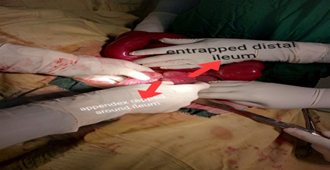
Figure 1: Intraoperative finding of appendicoieal knotting.
Discussion
Appendico-ileal knotting remains an exceedingly rare cause of small bowel obstruction (SBO), often presenting a significant diagnostic challenge. As evidenced by the collected case reports, the condition lacks a pathognomonic clinical presentation, with symptoms typically overlapping with other, more common, causes of SBO, such as volvulus, adhesions or hernias. This leads to most diagnoses being made intra-operatively, often as a "surprise" finding during exploratory laparotomy [15,16].
Table 1: *Summarized tables of few case reports of appendicoileal knotting.
| Author and year | age | sex | Clinical presentatio | Intraoperative findings | procedure | outcome |
| Mandal et al(2025) | 64 | male | Abdominal pain, vomiting, inability to pass stool and flatus. | Appendix mucocele knotting causing cecal and ileal gangrene | Limited right hemicolectomy and double-barrel stoma. | Uneventful postoperative recover |
| Abule T,Chebo T,Billoro BB,2022 | 30 | Female | Colicky abdominal pain, vomiting, and constipation | Appendico-ileal knot causing small bowel obstruction (SBO). | Untwisting of the knot, appendectomy | Uneventful recovery, discharged on day 4. |
| Idowu NA et al.,2024 | 72 | Male | Colicky abdominal pain, nausea, vomiting, constipation, and fever over 4 days. | Appendico-ileal knotting with gangrenous appendix and terminal ileum. | Limited right hemicolectomy and ileo-colonic anastomosis. | Discharged on postoperative day 10. |
| Kifle T et al 2018 | 46 | female | Acute abdomen with severe pain, bilious vomiting, and constipation for 7 days. | Confirmed appendiceal knotting with apperndicular mucocele causing SBO. | Laparotomy with untwisting of the knot, followed by appendectomy. | Recovered well. and discharged on the 5th post op date |
| Kabuye U et al.,2024 | 28 | female | Abdominal pain, vomiting, and constipation. Initial diagnosis was SBO from an intestinal band. | Appendix entangled around the terminal ileum, causing a closed-loop obstruction. The appendix was gangrenous, but the ileum was viable. | Retrograde appendectomy after releasing the knot. | Uneventful recovery, discharged on day 4. |
| Zewdu D et al.,2022 | 34 | male | SBO symptoms | Ileoappendicular knotting | Appendectomy, with resection of gangrenous bowel | Full recovery, though experienced post-op diarrhea. |
| Kassahun B et al., 2025 | 28 | male | Progressive lower abdominal pain, nausea, anorexia, and bilious vomiting for 2 days. | Gangrenous 20 cm appendix tightly encircling 1 m of gangrenous distal ileum. | Untwisting of the knot, appendectomy, resection of the gangrenous ileum, and end-to-side ileo-transverse anastomosis. | Uneventful recovery, discharged on postoperative day 6. |
| Klein et al.2024 | 80 | Female | Small bowel obstruction sign and symptom of 1 day duration | Appendicular knot of healthy appendex, obstructing the small bowel as closed loop obstruction | appendectomy | Discharged well |
| Alemu et al | 50 | Female | Abdominal pain, vomiting, abdominal distension. | Appendicoileal knotting with gangrenous ileum and appendix mucocele | Bowel and appendix resection with ileotransverse anastomosis | Discharged on the 7th post operative date |
| Lin, Tso-Lin et al 2017 | 4 | male | Vomiting, abdominal pain | Inflamed appendex causing appendiculoileal band knot | appendectomy | Discharged uneventfully |
The patient demographic in these cases varies widely, spanning from pediatric patients to the elderly. The specific pathophysiology depends on an elongated, mobile appendix, which can become inflamed and form a constricting band around a loop of the ileum. The outcome is critically dependent on the timing of surgical intervention. Early intervention, as seen in cases where the bowel remains viable, allows for a straightforward procedure involving the untwisting of the knot and appendectomy. In contrast, delayed presentation or diagnosis, especially in resource-limited settings, can lead to catastrophic complications such as bowel gangrene, perforation, and septic shock, requiring more extensive and complex procedures, such as bowel resection and anastomosis [1-10].
Histopathological findings, when available, sometimes reveal an associated mucocele of the appendix, as noted in the cases by Mandal et al. (2025) B and Alemu et al. (2023) [1,9]. This finding suggests that certain appendiceal pathologies might contribute to the knotting mechanism. In most cases appendicitis was mentioned as a preceding incident to appendicoileal knotting. Yet, only Klein et al (2024) reported the occurrence of appendico-ileal knotting in the presence of macroscopically and microscopically healthy looking appendex [8]. Our case also presented with the same finding with Klein et al. (2024) report. So, appendix can be a cause for small bowel obstruction in the presence of its inflammation or only mechanically as a band in the absence of its inflammation. There are two basic situations where the appendix may also cause a mechanical obstruction appendicular tip attached to the mesentery surrounding an ileal loop, producing compression of its lumen and the appendicular tip attached to the intestinal serosa, producing the obstruction by direct compression or torsion of a loop. The overall literature emphasizes that while appendico-ileal knotting is a rare event, a high index of clinical suspicion is necessary in patients presenting with SBO, especially in the absence of a clear etiology like a history of prior surgery. Early diagnosis and prompt surgical management are the cornerstones of successful treatment and significantly improve patient outcomes. But the overall management depends on the viability of the bowel or strangulation [11-15].
Conclusion
Appendico ileal knotting is still rare cause for small bowel obstruction. But as abdomen is “a Pandora box” the very rare things can happen and clinical suspicion is needed. Early diagnosis may help the patient for early surgical intervention. Appendico ileal knotting can occur in the absence of appendicitis.
Declarations
Acknowledgement
We would like to thank all leku general hospital clinical staffs who are involved in the management of the patient specially to the operating theater nurses andansthetists.
Funding
No fund for this case report
Informed Consent
Written informed consent was obtained from the patient for publication of this case report and accompanying images. A copy of the written consent is available for review by the Editor-in-Chief of this journal on request.
Ethical approval
N/A
Conflict of Interest
no conflict of interest.
Data Availability
All relevant data are within the paper and its Supporting Information files
References
- Mandal, M. K., Sarkar, N., Sarkar, S., & Mollah, J. (2025). A case of appendiculo-ileal knotting as a cause of gangrenous small bowel obstruction in a 64-year-old man in a Government Hospital, West Bengal, India. International Surgery Journal, 12(8):1383–1386.
Publisher | Google Scholor - Abule, T., Chebo, T., & Billoro, B. B. (2022). Appendico-ileal knotting causing small bowel obstruction: A case report. Clinical Case Reports, 10(5):e05878.
Publisher | Google Scholor - Idowu, N. A., Ismaeel, W. O., Adeleke, A. A., Faleye, J. A., Adeleye-Idowu, S. A., & Ademoye, K. A. (2024). Appendico-ileal knotting: A rare cause of strangulated small bowel obstruction. Ethiopian Journal of Health Sciences, 34(2).
Publisher | Google Scholor - Tadesse, K. A., & Samuel, T. (2018). Appendico-ileal knotting: A rare cause of small bowel obstruction. Journal of Surgical Case Reports, 2018(5):rjy088.
Publisher | Google Scholor - Kabuye, U., Damulira, J., & Okuku, M. D. (2024). Appendico-ileal knot: A rare form of small bowel obstruction: A case report. International Journal of Surgery Case Reports, 123:110194.
Publisher | Google Scholor - Wondwosen, M., Tantu, T., & Zewdu, D. (2022). Appendiceal knotting causing small bowel obstruction: A rare case report. International Journal of Surgery Case Reports, 93:106970.
Publisher | Google Scholor - Kassahun, B., & Afenigus, A. D. (2025). Gangrenous small bowel obstruction resulting from appendico-ileal knotting: A rare case report from Bete Markos Medical and Surgical Center, Ethiopia. Journal of Surgical Case Reports, 2025(7):rjaf539.
Publisher | Google Scholor - Klein Nulend, R., Quinn, R., Fok, K. Y., & Pathmanathan, N. (2024). The appendix: An unexpected band obstruction. Journal of Case Reports and Images in Surgery, 10(1):1–9.
Publisher | Google Scholor - Alemu, D. S., Arefayne, M., Bekele, T., Sahle, G., & Getachew, A. (2023). A case of appendiculo-ileal knotting as a cause of gangrenous small bowel obstruction in a 50-year-old woman in a private hospital. Journal of Surgery and Surgical Case Reports, 4(2):1036.
Publisher | Google Scholor - Lin, T.-L., et al. (2019). Intestinal obstruction caused by appendiceal knot. Pediatrics & Neonatology, 60(2), 216–217.
Publisher | Google Scholor - Bhandari, L., & Mohandas, P. (2009). Appendicitis as a cause of intestinal strangulation: A case report and review. World Journal of Emergency Surgery, 4:34.
Publisher | Google Scholor - Kibret, A. (2023). Ileo-ileal knotting: A rare cause of double loop small bowel obstruction, diagnostic and intraoperative challenge at Ethiopian Leku District Hospital, Sidama Region, April 2023: Case report. Clinical Surgery, 8:3657.
Publisher | Google Scholor - Hotchkiss, L. W. (1901). Acute intestinal obstruction following appendicitis: A report of three cases successfully operated upon. Annals of Surgery, 34:660–677.
Publisher | Google Scholor - Nulend RK, Quinn R, Fok KY, Pathmanathan N. (2024). The Appendix: An Unexpected Band Obstruction. Journal of Case Reports and Images in Surgery, 10(1):1-9.
Publisher | Google Scholor - M., J. G., K., S. A., A., L. J., & A., E. A. (2017). Intestinal obstruction caused by appendicitis: A systematic review. Journal of the West African College of Surgeons, 7(3):94.
Publisher | Google Scholor - Awale, L., Joshi, B. R., Rajbanshi, S., & Adhikary, S. (2015). Appendiceal tie syndrome: A very rare complication of a common disease. World Journal of Gastrointestinal Surgery, 7(4):67–70.
Publisher | Google Scholor