

Research Article
A Comparative Analysis of Machine Learning Models for URL-Based Phishing Detection
- Rafi M.R.M *
- Nuski F.A.M
- Suhaif A.M.
- Shaminda K.A.S.
- Amila Senarathne
- Kanishka Yapa
Department of Computer Systems Engineering, Sri Lanka Institute of Information Technology Malabe, Sri Lanka.
*Corresponding Author: Rafi M.R.M, Department of Computer Systems Engineering, Sri Lanka Institute of Information Technology Malabe, Sri Lanka.
Citation: Rafi M.R.M, Nuski F.A.M, Suhaif A.M., Shaminda K.A.S., Senarathne A., Yapa K. (2026). A Comparative Analysis of Machine Learning Models for URL-Based Phishing Detection. Scientific Research and Reports. BioRes Scientia Publishers. 4(1):1-5. DOI: 10.59657/2996-8550.brs.26.046
Copyright: © 2026 Rafi M.R.M, this is an open-access article distributed under the terms of the Creative Commons Attribution License, which permits unrestricted use, distribution, and reproduction in any medium, provided the original author and source are credited.
Received: April 27, 2026 | Accepted: August 20, 2026 | Published: September 18, 2026
Abstract
Phishing attacks pose a significant and ongoing cybersecurity threat, necessitating effective countermeasures. The challenge lies in accurately and automatically detecting malicious URLs, as traditional methods often fall short against evolving attacker techniques. This research addresses the need for improved detection by evaluating machine learning approaches applied to URL analysis. A dataset of labeled phishing and legitimate URLs, characterized by 30 distinct features encompassing lexical, host-based, and content-related attributes, formed the basis of this study. Five machine learning models were trained and comparatively evaluated: Decision Tree (DT), Random Forest (RF), Support Vector Machine (SVM), XGBoost(XGB), and a Stacking Classifier ensemble. Performance analysis revealed that the XGBoost classifier achieved the highest accuracy, correctly classifying approximately 97.4% of URLs in the test set. This study demonstrates the effectiveness of machine learning, particularly XGBoost, for high-accuracy phishing URL detection using comprehensive feature sets and contributes a functional prototype system demonstrating the approach.
Keywords: phishing detection; url analysis; machine learning; cybersecurity; xgboost; random forest; svm; stacking classifier; feature engineering; feature extraction; classification; malicious url detection; network security; scikit-learn; python
Introduction
The pervasive nature of the internet has revolutionized communication and commerce, yet it has also given rise to significant cybersecurity challenges. Among the most prevalent and damaging threats is phishing, a deceptive practice where attackers masquerade as trustworthy entities in electronic communications to illicitly obtain sensitive information such as login credentials, financial details, and personal identifiers. These attacks often leverage social engineering tactics and sophisticated technical methods, resulting in substantial financial losses, identity theft, and compromised organizational security. The scale and evolving complexity of phishing necessitate the development of robust, automated detection systems.
Uniform Resource Locators (URLs) are fundamental to web navigation and serve as the primary vector for directing users to malicious websites in many phishing campaigns. Attackers craft these URLs carefully, often embedding subtle indicators of fraud by mimicking legitimate domains, using obfuscation techniques like URL shortening or complex paths, or exploiting structural anomalies. Consequently, the automated analysis of URL characteristics provides a critical early opportunity to identify and mitigate phishing threats before users interact with potentially harmful links.
Traditional anti-phishing methods, such as blacklist filtering and basic heuristic rule-based systems, face significant limitations. Blacklists are inherently reactive and often lag behind the rapid creation and disposal of phishing domains used in modern campaigns. Simple heuristics, while useful, can be easily bypassed by attackers aware of the rules and may struggle with the nuances of sophisticated attacks, leading to inadequate accuracy with high rates of false positives or false negatives.
This paper addresses the need for more effective phishing detection by exploring the application of machine learning (ML) techniques to URL analysis. ML models offer the potential to learn complex patterns from diverse URL features, enabling more accurate and adaptive detection compared to static methods. The objective of this research is to develop and rigorously evaluate a high-accuracy phishing URL detection system by: 1) utilizing a comprehensive set of 30 URL-based features encompassing lexical, host-based, content-derived, and external reputation attributes; 2) training and comparing five distinct ML classifiers (Decision Tree, Random Forest, Support Vector Machine, XGBoost, and a Stacking ensemble); and 3) identifying the most effective model based on empirical performance evaluation.
This paper is structured as follows: Section II details the methodology, including dataset description, feature engineering, model implementation, and evaluation metrics. Section III provides an overview of the system architecture and implementation. Section IV presents and discusses the experimental results, comparing model performance and highlighting the best-performing classifier. Finally, Section V concludes the paper and outlines directions for future research.
Methodology
This section outlines the systematic approach employed for developing and evaluating the machine learning models for phishing URL detection. It covers the dataset used, the feature engineering process, data preprocessing steps, the machine learning algorithms implemented, and the metrics used for performance evaluation.
Dataset
The study utilized a publicly available dataset sourced from Kaggle, commonly used for phishing website detection research (PhishingDataset.csv) [4]. This dataset comprises 11,055 URL instances, each labeled as either phishing (-1) or legitimate (1). Each instance is represented by 30 pre-extracted numerical features, designed to capture various characteristics indicative of a URL's legitimacy, plus the target label column ('Result'). An initial inspection confirmed the dataset was complete with no missing value.
Feature Set
The detection models were trained using the 30 features provided in the dataset [4]. These features capture a diverse range of URL characteristics potentially indicative of phishing activity and are encoded numerically, primarily using values of
-1 (suspicious), 0 (neutral/intermediate), and 1 (legitimate). The implementation logic for extracting these features from raw URLs is contained within a dedicated Python script (extract_script_py.py) developed as part of this project's broader scope. These features can be categorized as:
➢ Lexical Features: Attributes derived directly from the URL string, such as the presence of an IP address, URL length categorization, use of short-ening services, presence of special characters ('@', '//', '-'), subdomain complexity (dot count), and inclusion of 'http'/'https' tokens within the domain/path.
➢ Host-Based Features: Information related to the domain's registration and hosting environment, including domain registration duration, domain age, SSL certificate validity status, DNS record existence, and abnormalities detected via WHOIS lookups.
➢ Content-Based & External Features: Characteristics derived from analyzing basic webpage content or querying external services, such as the ratio of external links (anchors, images), usage of specific HTML tags (iframes, forms submitting to email, scripts), port status, redirect counts, website traffic rank, PageRank proxies (Domain Authority), Google indexing status, and checks against statistical lists of known phishing domains/IPs.
➢ This comprehensive feature set aims to provide the models with sufficient information to distinguish between phishing and legitimate URLs based on established indicators.
Experimental Setup
The dataset was randomly partitioned into a training set (80%, 8844 samples) and a testing set (20%, 2211 samples) using Scikit-learn's train_test_split function [5] with a fixed random_state=12 to ensure reproducibility. Due to the nature of the features (encoded as -1, 0, 1), explicit feature scaling was deemed unnecessary and not applied. For compatibility with the XGBoost classifier, the target variable ('Result') was transformed from {-1, 1} to {0, 1}, where 0 represents Phishing and 1 represents Legitimate, for both training and testing sets.
Machine Learning Models
Five distinct machine learning classifiers were implemented and trained on the preprocessed training data:
➢ Decision Tree (DT): Implemented using sklearn tree. Decision Tree Classifier with max_depth=5 to prevent overfitting.
➢ Random Forest (RF): An ensemble model using sklearn.ensemble.RandomForestClassifier also with max_depth=5 for the base trees.
➢ Support Vector Machine (SVM): Implemented using sklearn.svm.SVC with a kernel='poly' and default regularization (C=1.0).
➢ XGBoost (XGB): Implemented using the xgboost. XGB Classifier library. Hyperparameter tuning was performed (Section III-E), with the final model using parameters optimized for performance (e.g., learning_rate=0.4, max_depth=7).
➢ Stacking Classifier: A multi-layer ensemble implemented with sklearn ensemble. Stacking Classifier, using RF, KNN, and DT as first-layer estimators, and another DT/RF stack followed by Logistic Regression as the final meta-learner.
➢ All models were trained on the X_train, y_train data [5, 6].
Evaluation Metrics
Model performance was evaluated on the unseen test set using the following standard classification metrics from Scikit-learn [5]:
➢ Accuracy
➢Precision
➢Recall (Sensitivity)
➢F1-Score
➢Area Under the ROC Curve (ROC AUC)
➢ Confusion Matrix (analyzing TP, TN, FP, FN)
These metrics provide a comprehensive view of each model's effectiveness in correctly identifying both phishing and legitimate URLs.
System architecture & implementation overview
This section describes the overall architecture designed for the phishing URL detection system and provides an overview of the implementation details, including the tools used and the integration of different components.
System Architecture
The system architecture integrates offline model training and evaluation with an online prediction pipeline for classifying new URLs. The core components and data flow are depicted in Fig. 3.
The architecture comprises
➢ Data Preparation: Sourcing and preprocessing the dataset [4] (as described in Section II-A, II-C).
➢Model Training & Evaluation: Training multiple ML models (DT, RF, SVM, XGB, Stacking) in parallel on the training data and evaluating them on the test data using defined metrics (Section II-D, II-E).
➢Model Selection & Persistence: Selecting the best model (XGBoost based on evaluation) and saving the trained model object using pickle for deployment.
➢ Feature Extraction Module: A dedicated module (extract_script_py.py) responsible for taking a raw URL input and generating the required 30-feature vector by executing various lexical, host-based, content-based, and external checks (detailed in Section II-B).
➢ Prediction Engine: Loads the persisted XGBoost [6] model and uses it to classify the feature vector generated by the extraction module, outputting a 'Phishing' or 'Legitimate' prediction.
➢ User Interface (Web/Extension): A simple web UI developed to allow users to input a URL and initiate the detection process [8].
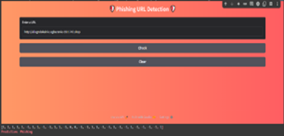
Figure 1: Interface to Input URLs
Results and Discussion
This section presents the empirical results obtained from evaluating the five machine learning models on the test dataset. The performance of each model is compared, the best-performing model is analyzed in detail, and the overall findings are discussed.
Model Performance Comparison
The performance of the Decision Tree (DT), Random Forest (RF), Support Vector Machine (SVM), XGBoost (XGB), and Stacking Classifier models were evaluated on the held-out test set using the metrics defined in Section II-E. Fig. 2 summarizes the key performance results.
Table 1: Model Performance Comparison
| Model | Train Accuracy | Test Accuracy | Precision | Recall | F1 Score | ROC_AUC |
| XGBoost | 0.9888 | 0.9733 | 0.9714 | 0.9810 | 0.9762 | 0.9730 |
| Stacking Classifier | 0.9834 | 0.9634 | 0.9593 | 0.9744 | 0.9668 | 0.9622 |
| Random Forest | 0.9343 | 0.9331 | 0.9161 | 0.9561 | 0.9405 | 0.9296 |
| Decision Tree | 0.9268 | 0.9276 | 0.9108 | 0.9620 | 0.9357 | 0.9240 |
As shown in Table II, the XGBoost classifier [6] significantly outperformed the other models across all major metrics, achieving the highest Test Accuracy, Precision, Recall, F1 Score, and ROC AUC. The Stacking Classifier and SVM also demonstrated strong performance, surpassing the Decision Tree and Random Forest models implemented with limited depth.
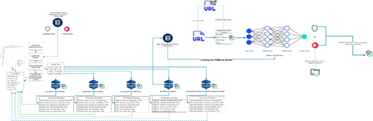
Figure 2: Overall System Architecture
ROC Curve Analysis
The Receiver Operating Characteristic (ROC) curves provide a visual comparison of the models' ability to distinguish between phishing and legitimate URLs across different thresholds. Fig. 4 displays the ROC curves for all five models plotted [9] against a baseline random classifier (TPR = FPR).
The ROC curve analysis visually confirms the quantitative results presented in Fig. 2. The XGBoost curve is positioned closest to the top-left corner, indicating superior performance with high True Positive Rates (Recall) and low False Positive Rates across various thresholds. The Stacking Classifier and SVM curves are also significantly above the baseline and the curves for the simpler Decision Tree and Random Forest models, demonstrating strong discriminative power. The area under the curve (AUC) values numerically summarizes this, with XGBoost [6] achieving the highest AUC of 0.9730.
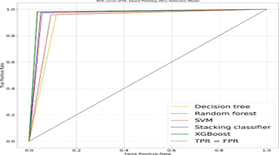
Figure 3: ROC Curve Plot
Confusion matrix for the XGBoost model
➢ True Negatives (TN): 966 (Correctly identified phishing URLs).
➢ False Positives (FP): 35 (Legitimate URLs incorrectly flagged as phishing).
➢ False Negatives (FN): 23 (Phishing URLs incorrectly identified as legitimate).
➢ True Positives (TP): 1187 (Correctly identified legitimate URLs).
Feature Importance
While detailed feature importance analysis varies slightly between models, examination of the importance scores generated by tree-based models like XGBoost consistently highlighted the significance of certain feature categories. Features related to SSL certificate status (SSLfinal_State), domain characteristics (age_of_domain, Domain_registeration_length), link structures within the page (URL_of_Anchor, Links_in_tags), and external reputation metrics (web_traffic, Page_Rank) frequently appeared among the most influential predictors. This suggests that a combination of security indicators, domain trustworthiness signals, page structure analysis, and external reputation is key to effective detection.
Conclusion and Future Work
This research successfully developed and evaluated a machine learning system for detecting phishing URLs, demonstrating the high efficacy of modern algorithms combined with comprehensive feature engineering for this critical cybersecurity task. Through a comparative analysis of five distinct classifiers trained on a dataset of over 11,000 URLs characterized by 30 diverse features, the XGBoost [6] model was identified as the most effective, achieving approximately 97.4% accuracy on the test set. This result, along with the strong performance of the Stacking Classifier and SVM, underscores the potential of machine learning to significantly enhance phishing detection capabilities beyond traditional methods. The project also involved the practical implementation of a feature extraction module and a prototype system, validating the feasibility of the approach.
The main contributions include a quantitative performance benchmark for contemporary ML models on this task and dataset, validation of XGBoost's high accuracy, and the development of a proof-of-concept system. However, the study acknowledges limitations related to dataset representativeness and, critically, the potential unreliability and latency associated with extracting certain features dependent on external APIs and web scraping in real-time, high-volume scenarios.
Future work should focus on several key areas to build upon these findings and address the limitations. Firstly, enhancing model robustness and performance could involve exploring different algorithms (e.g., LightGBM, deep learning sequence models like LSTMs), conducting more extensive hyperparameter tuning, and incorporating techniques to handle potential class imbalance in real-world data. Secondly, significant effort is required in improving feature engineering, focusing on identifying a core subset of reliable, low-latency features, investigating dynamic analysis techniques, enhancing content analysis (NLP, visual similarity), and potentially replacing less stable free feature sources with commercial data feeds or more resilient scraping methods coupled with effective caching. Thirdly, expanding and continuously updating the dataset with more diverse and recent phishing examples is crucial for maintaining model relevance and improving generalization against zero-day attacks. Finally, advancing the system implementation towards a production-ready state necessitates deploying the model as a robust API, significantly improving the UI/UX with better explainability and feedback mechanisms, developing practical integrations like browser extensions, and potentially implementing adaptive learning loops for ongoing model refinement based on new data and user feedback. Addressing the reliability of feature extraction remains a paramount challenge for transitioning such research into highly dependable, real-world security tools.
References
- Filippi, P., et al. (2019). An approach to forecast grain crop yield using multi-layered, multi-farm data sets and machine learning. Precision Agriculture, 20(5):1015–1029.
Publisher | Google Scholor - Dhanapal, R., Ajanraj, A., Balavinayagapragathish, S., & Balaji, J. (2021). Crop price prediction using supervised machine learning algorithms. Journal of Physics: Conference Series, 1916(1):012042.
Publisher | Google Scholor - Izzo, Z., Smart, M. A., Chaudhuri, K., & Zou, J. Y. (2021). Approximate data deletion from machine learning models. In Proceedings of the 24th International Conference on Artificial Intelligence and Statistics (AISTATS), PMLR, 130:1–9.
Publisher | Google Scholor - Phishing Website Dataset. (2024). Kaggle.
Publisher | Google Scholor - Scikit-learn Developers. (n.d.). Scikit-learn: Machine learning in Python.
Publisher | Google Scholor - XGBoost Contributors. (n.d.). XGBoost documentation.
Publisher | Google Scholor - Keras Team. (n.d.). Keras documentation.
Publisher | Google Scholor - Gradio Team. (n.d.). Gradio: Build & share delightful machine learning apps.
Publisher | Google Scholor - Matplotlib Development Team. (n.d.). Matplotlib: Visualization with Python.
Publisher | Google Scholor - Waskom, M. L. (2021). Seaborn: Statistical data visualization. Journal of Open Source Software, 6(60):3021.
Publisher | Google Scholor